


Have you ever sent a massive march of your strongest troops against an enemy city, only to watch them evaporate within seconds? Or wondered why some players' keeps seem to absorb rally after rally without their main forces being wiped out?
In this guide, we're breaking down troop layering in a simple, practical way so you can start improving both your attacking marches and your city defense immediately. Whether you're a Keep 25 player trying to survive your first Server vs. Server (SvS) or a seasoned K40 looking to optimize your rally defenses, understanding layers is the difference between owning strong troops and knowing how to use them properly.
Let's dive in.
What Is Troop Layering?
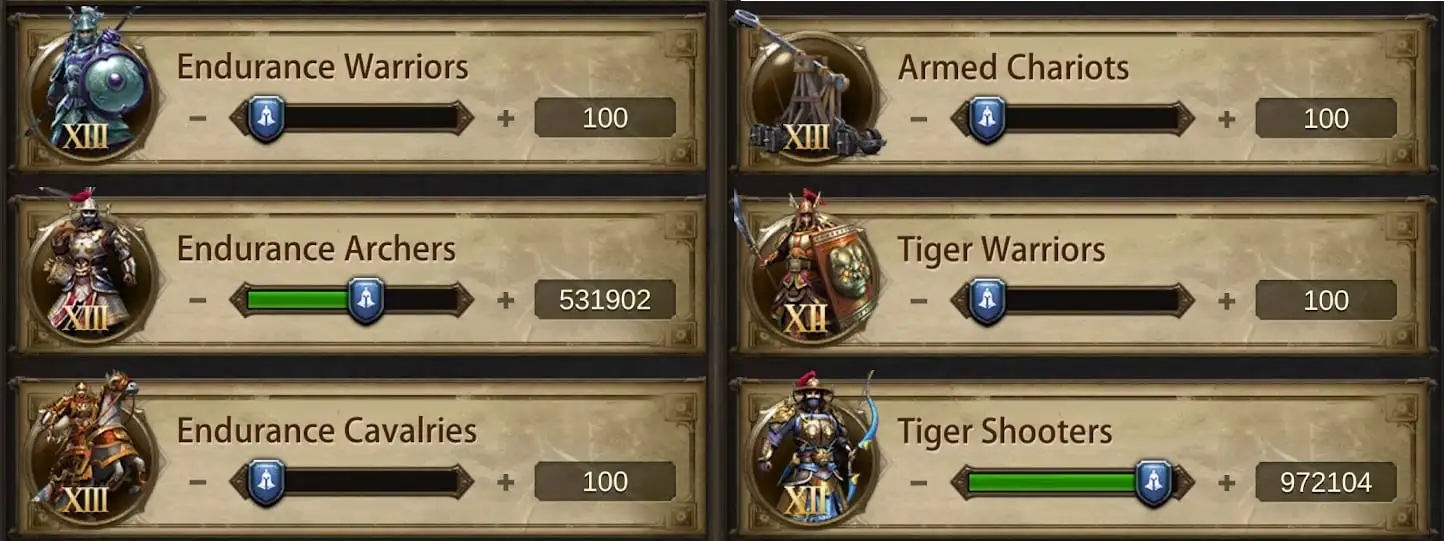
In simple terms, troop layering means using multiple troop tiers and troop types within the same battle setup.
Instead of sending nothing but your strongest troops, you include smaller groups of lower-tier troops alongside your main attacking force. These can include troops from Tier 1 all the way up to your highest available tier—across Ground, Mounted, Ranged, and Siege.
These smaller groups are known as layers. Think of them as additional obstacles that the enemy must work through before they can concentrate entirely on your most valuable troops.
The concept applies to both offense and defense, though the execution differs significantly between the two. On defense, layers tend to be much thicker because your city isn't restricted by march size limits. On offense, layers must be thinner because every troop you add takes up precious space in your march.
Why Troop Layering Works
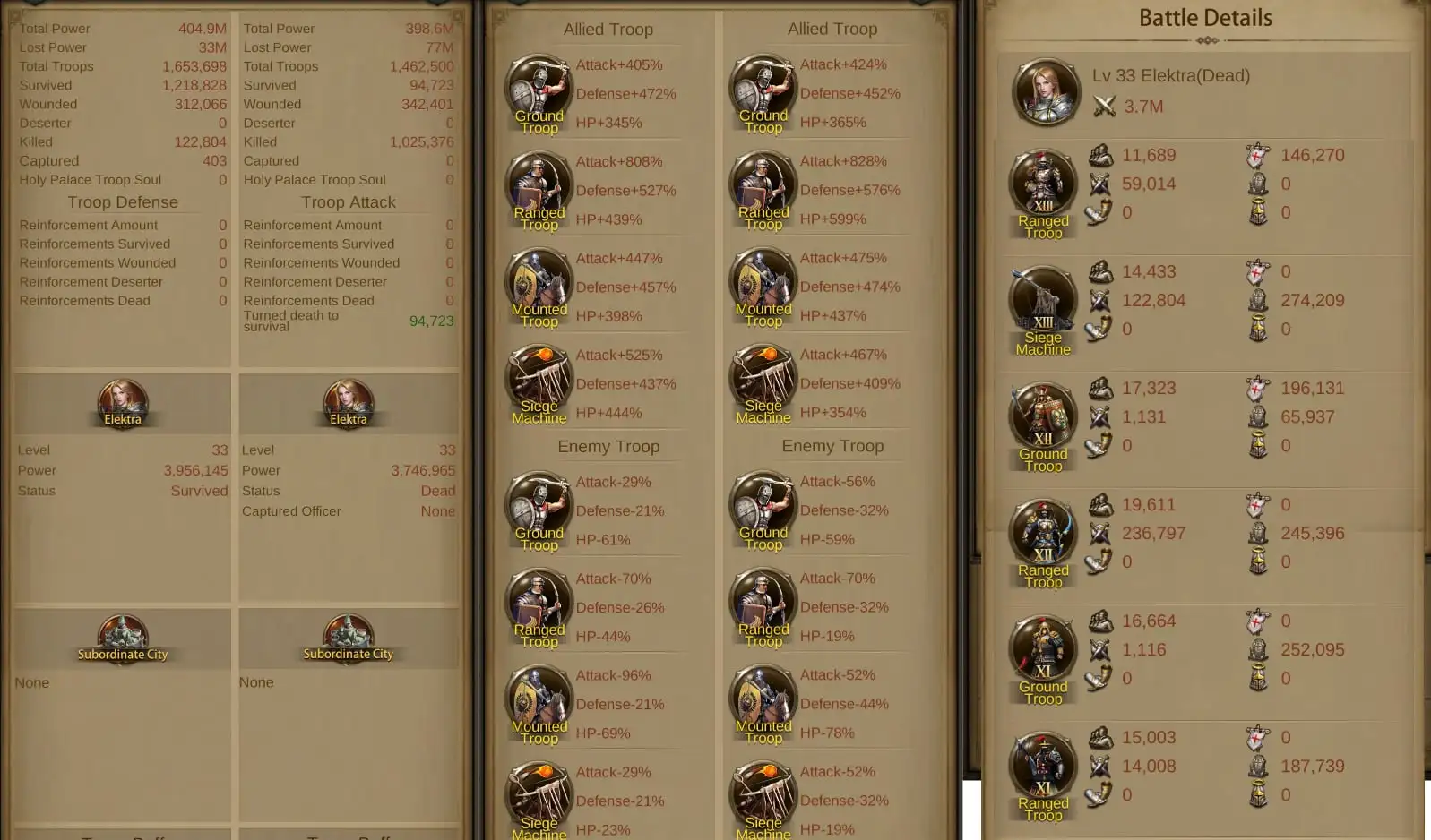
Troop layering matters because Evony battles take place across multiple combat rounds. Each troop type and tier operates as its own group during the battle, and in each round, each troop type targets one specific enemy group.
If you send a march made entirely from one high-tier troop type, the enemy can concentrate its attacks on that main stack very quickly. For example, sending nothing but T14 Ranged troops may look powerful, but it gives the enemy fewer separate groups to work through.
A layered march adds smaller groups of different tiers and troop types. The enemy must interact with those additional layers during combat, which can help protect your main stack and allow it to remain effective for longer.
Here's the key insight: Each layer effectively "buys you a round" in combat. If you're not using layers and your enemy is, you will suffer severe losses—even on attacks or defenses where you have the troop-type advantage.
The layers themselves may be small—sometimes just a few hundred or thousand troops—but their impact on the battle can be significant. The battle mechanics aren't fully public, but years of player testing have proven that a well-layered army can dramatically delay enemy progress, allowing your higher-tier troops to deal more damage while minimizing losses.
Defensive Layers: Protecting Your Keep
Defensive layers work differently from attacking because your city is not restricted by a normal march size limit. That means defensive layers can become much thicker over time.
Defensive Layer Guidelines by Keep Level
Here's a simple starting guide for defensive layers:
|
Keep Level |
Recommended Layer Size |
|---|---|
|
25 or Lower |
5,000–10,000 of each troop tier and type |
|
26–30 |
20,000–50,000 of each troop tier and type |
|
30–33 |
50,000–100,000 of each troop tier and type |
|
33–35 |
200,000+ of each troop tier and type |
|
35+ |
500,000–1,000,000+ per layer |
Important: These are not fixed numbers that every account must follow. Your ideal defense depends on your troop totals, generals, refines, buffs, and overall defensive strategy.
The 2026 Defensive Meta Shift

The defensive layering meta has evolved significantly. What worked in 2023–2025 is no longer sufficient against modern attack compositions.
Previously, many PvP-focused players ran 5K–10K layers, occasionally 50K for stronger accounts. The goal was simple: keep overall power lower, look attractive for solo attacks, and trap aggressive players.
But the game has changed.Three major factors are driving this shift:
- Massive Attack Buff Inflation– Top accounts now run 5000%+ attack buffs with ascended generals, premium dragons, and advanced civilization gear. Thin layers simply evaporate too quickly.
- Stronger Debuffs– Defensive debuffs in 2026 regularly hit 2000%+, with multiple stacked subordinate city effects.
- Hybrid Marches & Rally Meta– The rise of hybrid marches, multi-layered offensive compositions, and massive coordinated rallies has completely changed defensive requirements.
The T1 Mounted Defense
One common defensive setup uses extremely large numbers of T1 Mounted troops—sometimes 100 million or more. These troops act as a massive defense layer and are often cheaper to produce and heal than higher-tier troops.
However, simply training millions of T1 Mounted troops does not automatically create a strong defense. That strategy still needs:
- The correct wall general equipment and refines (prioritizing flat Mounted HP refines on helmet and pants)
- Proper research
- Strong debuffs
- Supporting troop layers across all tiers and types

Offensive Layers: Building Your PvP Marches
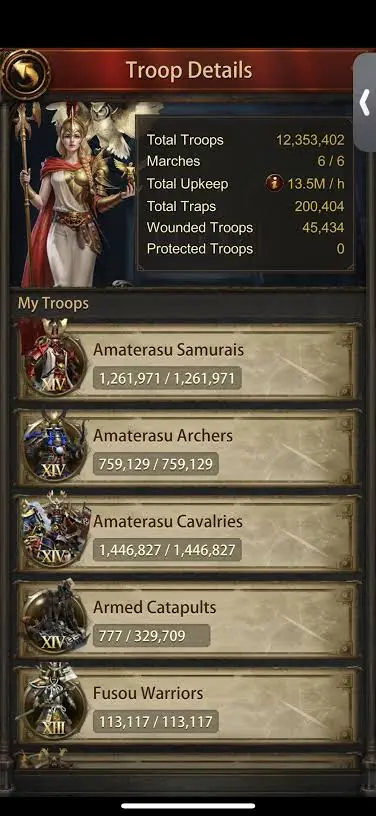
For attacking, layers need to be much thinner because every troop added takes up space within your march. Most of the march should still be made up of the troop type you intend to attack with. The additional layers are there to support that main stack, not replace it.
The General Formula for Offensive Layers
A well-structured offensive march follows this general formula:
- Top Tier Troops: 35–60% of your march
- Second Tier Troops: 15–30% of your march
- Third Tier Troops: 5–20% of your march
- Other Tiers of the Same Type: 0.25–2% of each lower tier
- All Other Troop Types: 1–10,000 troops to create distractions and absorb hits
Ranged March Composition
For a Ranged march, a simple structure could look like this:
- 25–40% Top tier Ranged (e.g., T14)
- 25–40% Second highest tier Ranged (e.g., T13)
- 10–40% Third highest tier Ranged (e.g., T12)
- Small layers from the remaining Ranged tiers
- Thin layers from Ground, Mounted, and Siege troops
Some advanced players recommend a 30/30/40 or 25/25/50 split for Archer marches, with the largest portion in the highest tier.
Example: For a 1 million troop Ranged march:
|
Troop Tier |
Quantity |
|
T14 Ranged |
400,000 |
|
T13 Ranged |
300,000 |
|
T12 Ranged |
150,000 |
|
Other Ranged Tiers |
~20,000 each |
|
All Other Troops |
~1,000 each |
Ground March Composition
For a Ground march:
- 35–60% Top tier Ground
- 15–30% Second highest tier Ground
- 5–20% Third highest tier Ground
- Small layers from remaining Ground tiers
- Thin layers from other troop types
Mounted March Composition
Mounted marches follow a similar structure, with most of the march dedicated to the strongest Mounted tiers and smaller layers added around them. The default recommended distribution for Mounted is approximately 45% top tier, 23% second tier, and 10% third tier.
Understanding Troop Counters
Before you build any march, remember the rock-paper-scissors dynamic:
- Mounted beats Ground
- Ground beats Ranged
- Ranged beats Mounted
- Siege is best against other Siege
Always scout your enemy first and identify their dominant troop type. If they have mostly Mounted troops, send a Ranged march. For beginners, Ranged is often the strongest option in early-to-mid game PvP.
One critical rule: Never mix troop types as your main force. While you should include thin layers of all types, your primary damage dealers should be a single troop type. If you mix, no matter what you're hitting, one of your troop types will be directly countered by what the enemy has, causing unnecessary losses.
How to Create Your Layered Presets
Setting up your attacking layers efficiently is crucial for PvP success. Here's how to do it:
Step-by-Step Preset Setup
- Open your Rally Spot and go to March Presets.
- Create separate presets for Ranged, Ground, and Mounted marches.
- Start by adding your main high-tier stack for the chosen troop type.
- Add your layers: Here's a time-saving trick that many players miss:
- Click "Reset" to zero out all troops
- Find the "Full Tiers" button
- Long-press the "Full Tiers" button—this opens a pop-up box where you can input your desired troop count per layer (e.g., 2,000)
- Click "OK," then click the green "Full Tiers" button to apply it across all layers instantly
- Fill the remaining march capacity with your top three tiers of the chosen troop type.
- Save the preset so you can load it quickly during PvP events.
Defensive Troops
Your defensive troops do not need to be saved as a march preset. For city defense, continue training and gradually increasing your layers as your account grows. Do not try to build everything overnight—strong defensive layering takes time, resources, and a clear plan.
Final Tips
Start Small, Scale Up
You do not need a perfect setup immediately. Even adding around 1,000 troops from each available tier and troop type can be a major improvement over sending one pure stack.
Study Your Battle Reports
As your keep level increases, gradually thicken your defensive layers and adjust your attacking ratios by studying your battle reports. The exact numbers will depend on your available tiers, march size, buffs, and target. Use the figures in this guide as starting points, not as perfect formulas for every battle.
Layer Sizes by Account Power
Depending on your keep's power:
- 50–100 million power: As few as300 troops per layer
- 500+ million power:1,000 or more per layer
The Bottom Line
Troop layering is one of the biggest differences between simply owning strong troops and knowing how to use them properly. It's not about having the highest-tier troops—it's about how you deploy them.
Whether you're defending your keep against a massive rally or launching an attack during SvS, mastering troop layers will give you a distinct advantage that raw power alone cannot provide.
Conclusion
Troop layering is the foundation of effective PvP combat in Evony: The King's Return. It transforms your army from a one-dimensional brute force into a sophisticated battle formation that can absorb damage, confuse enemy targeting, and protect your most valuable troops.
Start layering today, and watch your PvP performance transform. The troops you already have might be stronger than you think—they just need the right support around them.






 TOP UP WITH DISCOUNT NOW
Rich Experienced Game Editor
Rich is a passionate gamer and strategy explorer who loves uncovering hidden mechanics, experimenting with team comps, and sharing tips that actually help players succeed. She has a talent for breaking down complex systems into easy-to-understand guides, making even the trickiest battles feel manageable. When she's not diving into virtual worlds, you might find her debating game lore, hunting for easter eggs, or enjoying a snack while plotting her next in-game strategy. Rich's goal? Helping fellow gamers have more fun while leveling up their skills.
