


State migration is a vital seasonal balance mechanism in Last Z: Survival. Modern cross-server transfers are strictly regulated by the official Migration Score system, which standardizes account strength evaluation, player tier division, quota limits, and migration access rules. A clear understanding of this system is essential for successful seasonal server relocation.
LDShop will break down its core rules covering scoring, tiers, server types, event stages, costs and requirements to help you transfer servers smoothly and avoid mistakes!
👇LDShop offers the best deals to top up Last Z. Visit the Last Z top up page to see more.
Core Definition and Essence of Migration Score
Official Definition
Migration Score is an official comprehensive rating system designed to assess the overall maturity and comprehensive strength of player accounts. It acts as the sole authoritative standard for determining a player’s migration tier, migration pass consumption, server access eligibility, and quota competitiveness during seasonal cross-state migration events.
Core Calculation Dimensions
Notably, Migration Score is not calculated based on real-time combat power or troop quantity. It focuses entirely on permanent account development progress and historical strength records, covering the following official evaluation dimensions:
- Building Power and HQ Level (Core Weight): Permanent base construction progress and headquarters tier are primary determinants of Migration Score.
- Tech Research Progress (Core Weight): Military and economic technology development reflects long-term account growth and greatly influences final scoring.
- Hero Development: Hero levels, skill progression, and overall hero combat power are included in comprehensive evaluation.
- Modified Vehicle Power: The strength of modified vehicles contributes to the overall Migration Score calculation.
- Historical Peak Combat Power (Key Hidden Rule): The highest combat power an account has ever reached takes precedence over current real-time strength.
- Auxiliary Evaluation Factors: Arena rankings and past server president identity records serve as secondary reference indicators.
Fixed Mechanism Characteristics
The Migration Score system has unchangeable core characteristics that all players must understand to avoid judgment errors:
- The system only records a player’s historical highest score, and the score will never drop passively.
- Temporary disbanding troops or reducing real-time combat power cannot lower the Migration Score or adjust migration tiers.
- Unused resources, cores, fragments, and inventory equipment are not included in the official score calculation.
Dynamic Migration Tier System
Four Standard Tier Classification
Based on the calculated Migration Score, all players are divided into four fixed migration tiers. Although different seasonal updates may adjust tier aliases, the hierarchical logic remains consistent: Regular, Medium, Advanced, and Elite. Each tier corresponds to independent migration costs, quotas, and access permissions.
Dynamic Tier Threshold Mechanism
Migration tier thresholds are not fixed numerical values. The official dynamically adjusts the judging standards for each season according to multiple ecological factors:
- Server opening duration and seasonal cycle progress
- Overall development level of the entire server group
- Strength distribution of active players in the current cycle
In practical gameplay, newly opened server groups have lower tier thresholds, while mature, highly developed server groups adopt stricter and higher strength standards. This dynamic adjustment may cause veteran players to be reclassified into different tiers across different seasons.
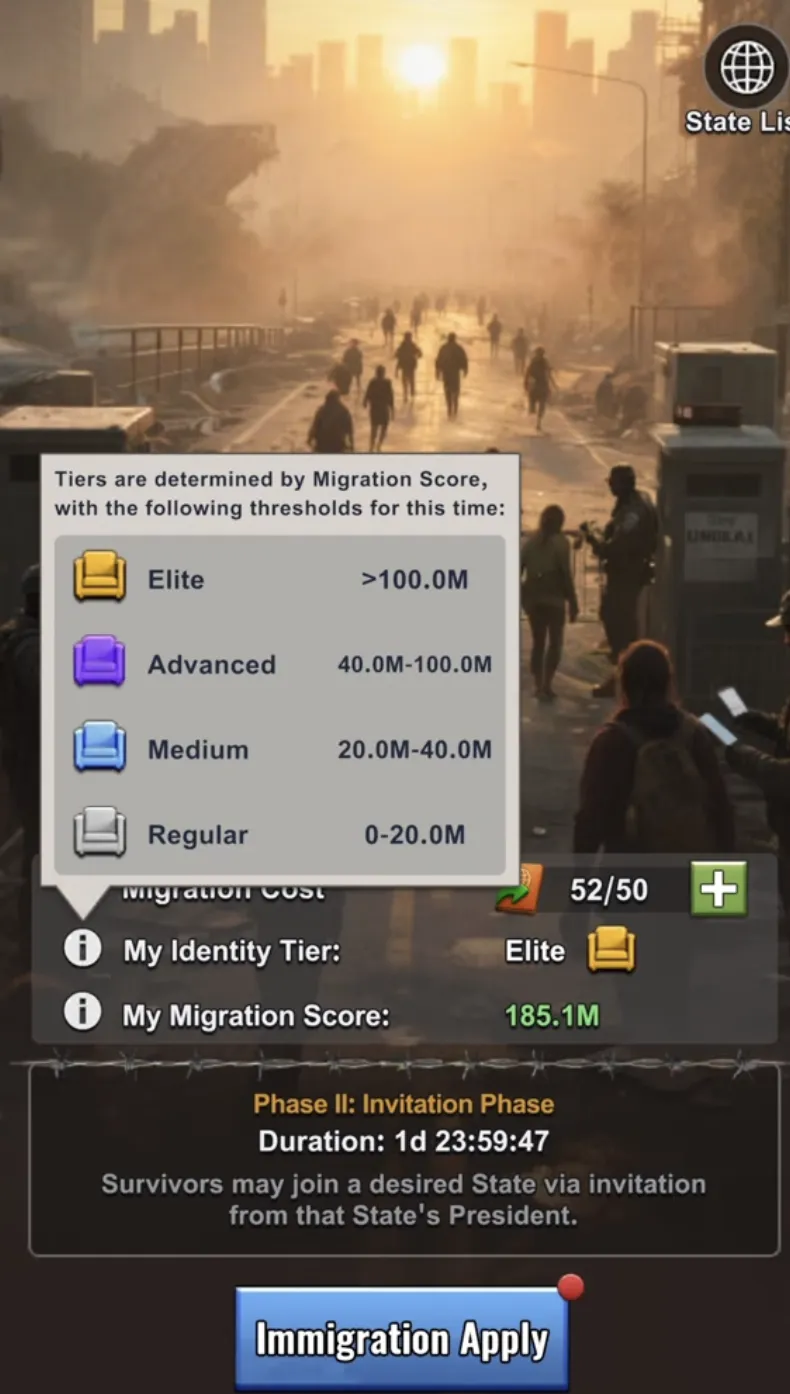
Core Differences Between Tiers
A player’s migration tier directly determines three core migration rights throughout the event: the number of migration passes required for transfer, the number of available server quotas, and the applicable cross-server application authority. Higher tiers face stricter restrictions and higher migration costs.
Server Classification and Tier Quota Rules
Official Server Classification Standards
Before the launch of each migration event, the system conducts a comprehensive data evaluation of all servers. The evaluation is based on active player data, overall server combat strength, high-tier player distribution, and large-scale battle activity records. All servers are classified into three categories with different migration restriction levels:
- Fully Open State: Loose migration rules with increased total migration slots and minimal access restrictions.
- Regular State: Follows the official standard quota configuration and implements basic migration rules.
- Semi-Open / Flourishing State: Strictly restricted servers with reduced high-tier migration slots. This balance mechanism prevents top-tier servers from forming an absolute monopoly and maintains overall server ecological fairness.
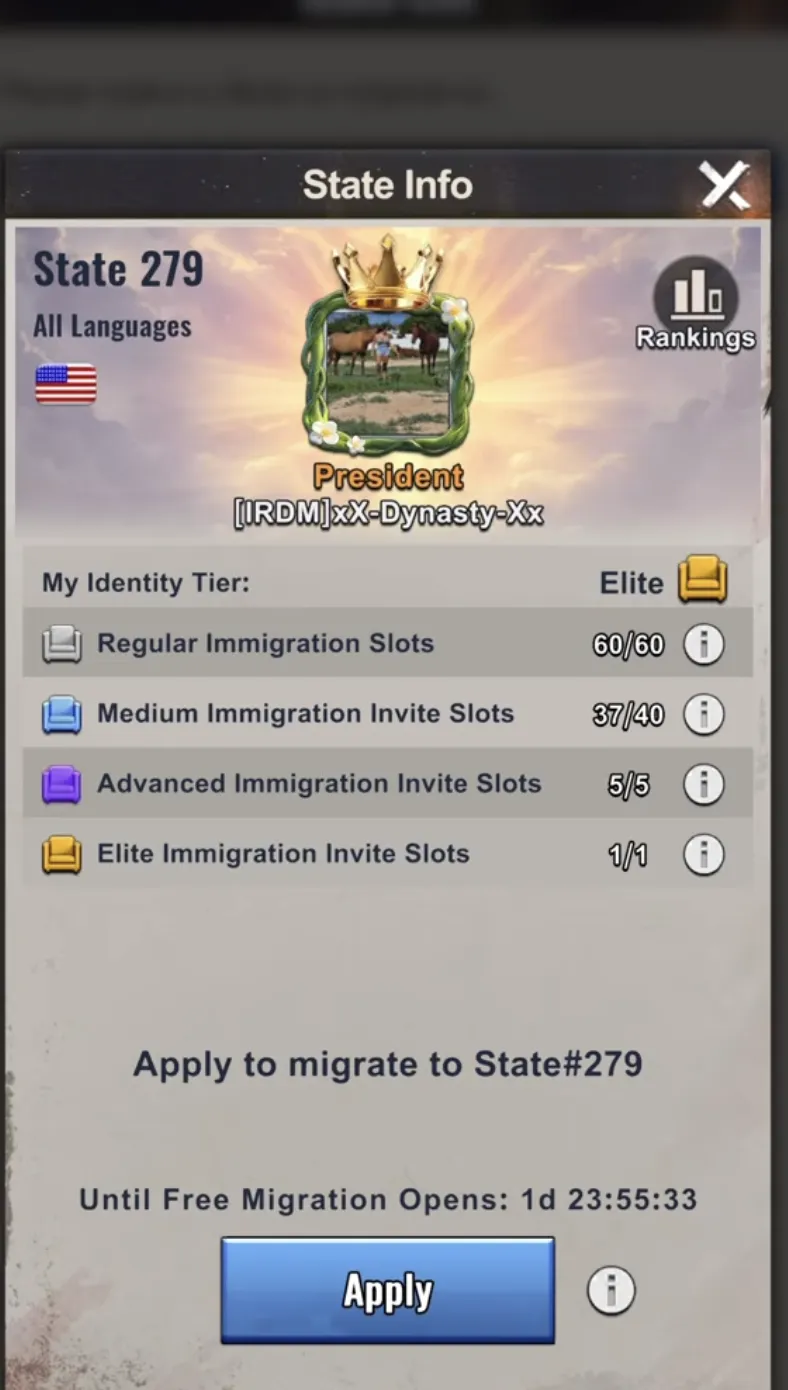
Standard Tier Quota Configuration
Regular server groups adopt unified official fixed quotas. Taking the 193–208 server cluster as a standard example, the tier-based migration slots are allocated as follows:
- Elite Tier: 1 slot
- Advanced Tier: 5 slots
- Medium Tier: 40 slots
- Regular Tier: 60 slots
Quota Adjustment for Restricted Servers
Semi-Open and Flourishing servers further compress high-tier migration quotas to control the inflow of top-strength accounts:
- Elite tier slots may be reduced to zero, completely banning elite player migration.
- Advanced tier slots are reduced from 5 to 3.
- Medium and Regular tier quotas remain unchanged to ensure basic server player mobility.
The core rule is clear: the stronger and more developed a server’s ecosystem is, the stricter the migration restrictions for high Migration Score players.
Migration Pass Cost and Acquisition System
Tier-Based Pass Consumption Standards
Migration pass consumption is strictly tier-matched, with a progressive cost increase for higher tiers, forming a hierarchical restriction system for strong accounts:
- Regular Tier: 10 Migration Passes
- Medium Tier: 15 Migration Passes
- Advanced Tier: 20 Migration Passes
- Elite Tier: 50 Migration Passes
Elite players face the most severe triple restrictions: the highest pass consumption, the fewest available quotas, and mandatory presidential approval, making elite migration the most competitive and difficult operation.
Official Pass Acquisition Channels
Migration Passes can only be obtained through two official channels, both with fixed acquisition limits:
- Free-to-Play Channel: Players can purchase 1 Migration Pass per week from the Glory Shop at the cost of 5,000 Glory Badges, with a permanent weekly limit.
- Paid Channel: Limited-time event packs are launched during migration seasons, including 5-pass and 20-pass packages. All paid packs have purchase caps and cannot be infinitely purchased.
Long-Term Accumulation Cycle
Pure free accumulation requires long-term seasonal preparation. To collect enough passes for a single migration, Regular tier players need 10 weeks, Medium tier 15 weeks, Advanced tier 20 weeks, and Elite tier up to 50 weeks. This rule proves that migration preparation is a long-term seasonal task rather than a temporary operation.
Three-Stage Official Migration Event Mechanism
All seasonal state migration events follow a unified three-phase cycle. Each phase has independent operation permissions and rules, and players can only perform corresponding operations within the specified time window.
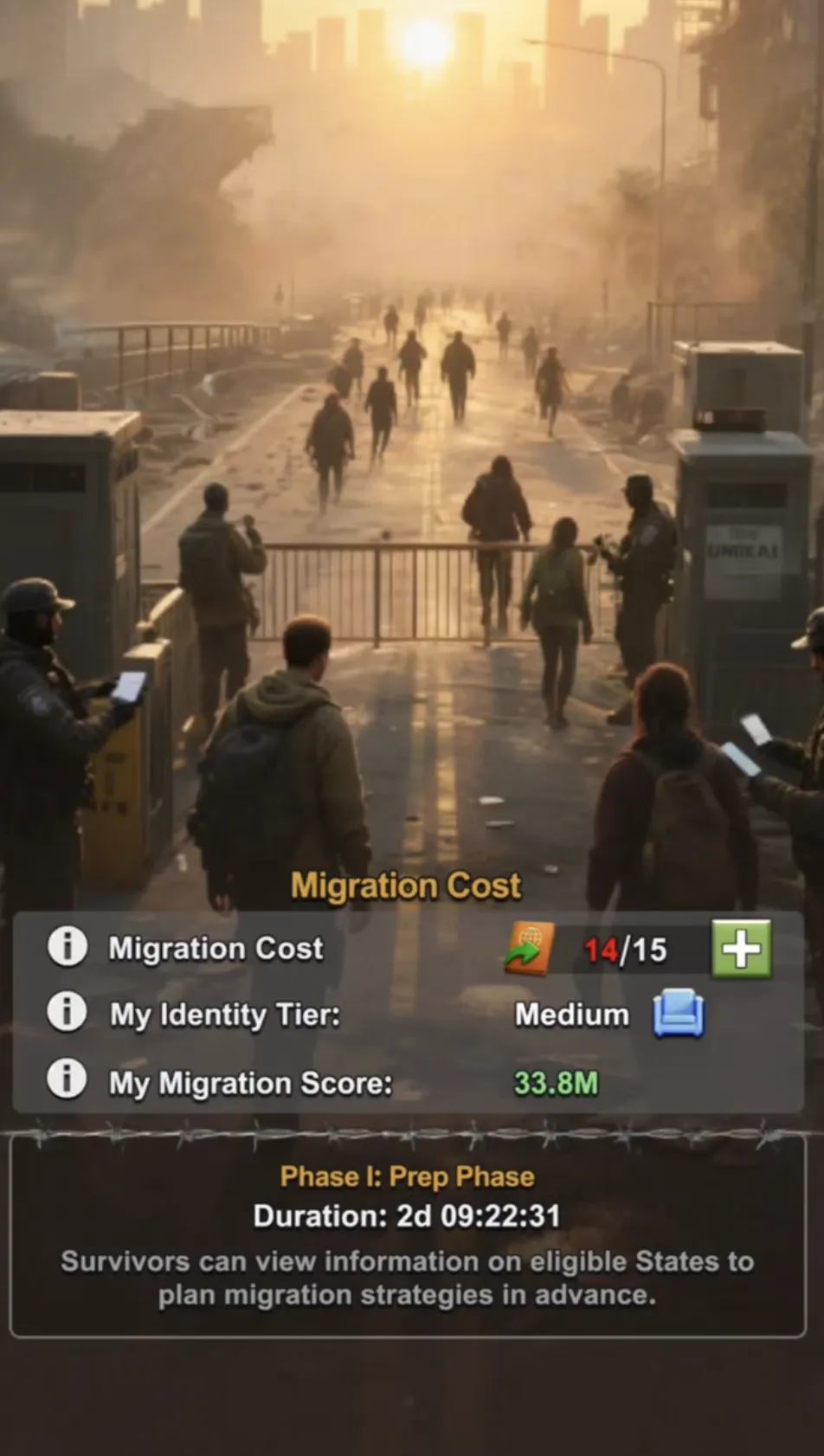
Phase 1: Preparation Phase
This initial phase serves as the information collection and pre-preparation stage with no migration application access:
- Players can check their personal Migration Score and corresponding migration tier.
- Players can query all server types and remaining tier-based migration quotas.
- Players can contact target server management teams to confirm pre-migration arrangements.
The core value of this phase is to confirm personal migration qualifications and formulate targeted transfer plans in advance.
Phase 2: Invitation and Application Phase
This phase opens official cross-server application and invitation functions with clear authority divisions:
- Server presidents can actively send cross-server migration invitations to external players.
- Medium, Advanced, and Elite tier players can submit official migration applications to target servers.
- All invitations and applications are valid for 24 hours. Rejected applications trigger a 20-minute cooldown before re-submission.
Phase 3: Free Migration Phase
Free migration permissions are strictly limited to low-tier players, forming an obvious tier privilege gap:
- Regular Tier Players: Free migration is allowed to any server with remaining Regular quotas, no invitation or approval required.
- Medium/Advanced/Elite Tier Players: Free migration is prohibited. Transfers are only permitted via target server invitations or presidential approval.
Full Mandatory Migration Access Conditions
All the following official hard conditions must be met simultaneously to complete cross-state migration. No exceptions or special privileges are allowed:
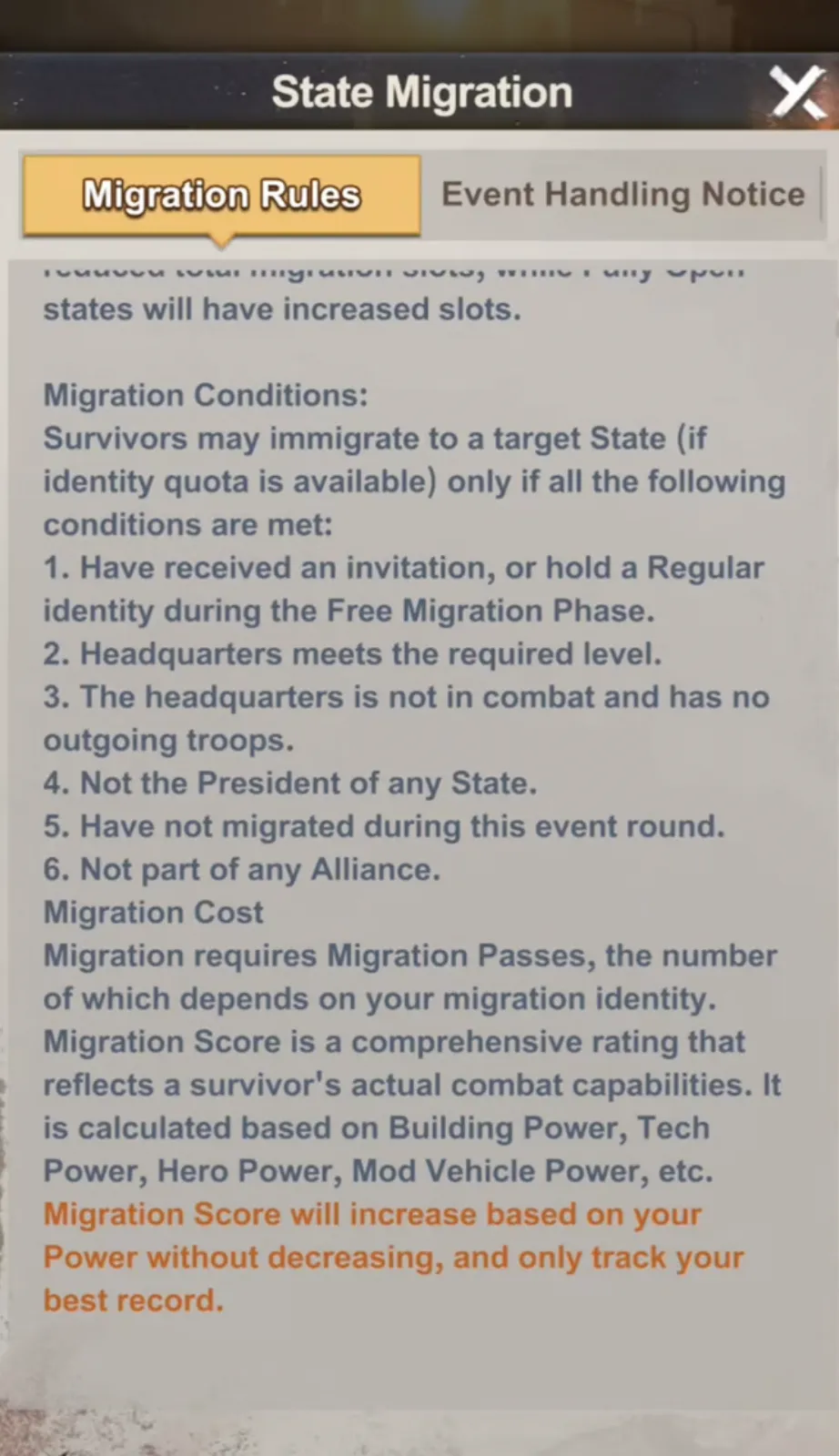
- Quota Requirement: The target server has remaining migration slots corresponding to the player’s tier.
- Qualification Requirement: Obtain an official invitation from the target server (exempt for Regular tier players during the free migration phase).
- Base Status Requirement: The headquarters meets the official level standard, remains out of combat, and has no outgoing troops.
- Identity Restriction: The player is not the current president of any server.
- Event Restriction: The player has not completed any migration in the current seasonal event round.
- Alliance Restriction: The player must quit their current alliance before initiating migration.
- Resource Requirement: The player owns sufficient Migration Passes matching their tier standard.
Global Migration Restriction Rules
The official system sets universal restrictions to prevent excessive frequent migration and server ecological chaos:
- Single Event Limit: Each player can only complete one migration per seasonal migration event.
- Global Cooldown: A 30-day migration cooldown is triggered immediately after any successful transfer.
- Group Migration Rule: No hidden restrictions apply to team migration. Multiple players can transfer together as long as individual qualifications and quota conditions are satisfied.
Post-Migration Account Mechanism Changes
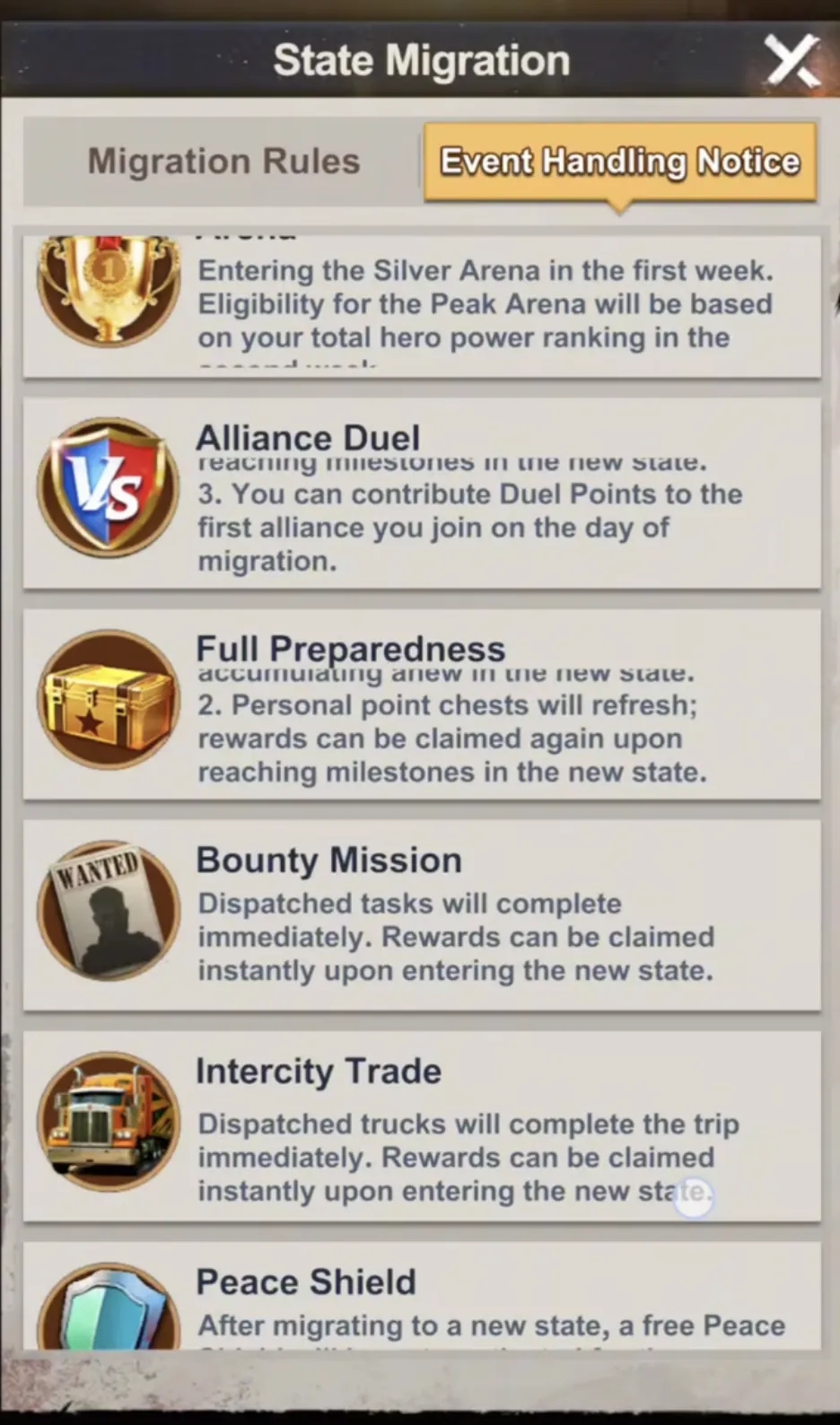
All core account progression data is fully retained after migration. Only system display data and activity states are reset or updated:
Retained Account Content
All permanent account progress is completely preserved, including building levels, tech research, hero development, troop strength, in-game resources, speed-up items, and all functional props.
Updated and Reset Content
- Ranking Data: Removed from the original server ranking list and incorporated into the new server’s ranking system.
- Arena System: All migrated players enter the Silver Arena for the first week after transfer, regardless of original strength.
- Duel System: Personal duel points are fully reset, and personal point chests are refreshed for new rewards.
- Task System: Ongoing bounty missions and dispatch tasks are automatically completed and claimable; dispatch truck data is cleared.
- Server Activities: Different servers operate independent weekly event cycles, leading to different available seasonal activities after migration.
Common Rule-Based Migration Failure Causes
Most migration failures stem from misunderstandings of official mechanisms rather than insufficient account strength. The standardized rule-based failure reasons are summarized as follows:
- Inadequate long-term pass accumulation, failing to meet the tier-based consumption standard.
- Misinterpreting the score mechanism and attempting to lower tiers by reducing temporary real-time power.
- Missing the optimal time window for preparation and application, resulting in exhausted target server quotas.
- Ignoring hard access conditions, such as retaining alliance membership, unfinished troop dispatch, or combat-status bases.
- Target Flourishing/Semi-Open servers have exhausted high-tier quotas, including zero elite slot availability.
Mechanism Summary and Core Design Logic
The Migration Score system is the core ecological balance foundation of Last Z: Survival seasonal cross-state migration. Its core design logic is to maintain long-term server fairness and ecological balance through three dimensional controls: individual account strength grading, overall server strength classification, and phased migration authority management. A successful migration relies entirely on matching personal tier qualifications, target server quota status, event phase rules, and full compliance with official access conditions. Mastering the complete Migration Score mechanism allows players to formulate scientific seasonal migration plans and avoid unnecessary operational failures.
Conclusion
This guide fully explains Last Z’s state transfer rules based on the Migration Score system. We’ll walk you through score calculations, player tiers, server quotas, pass costs & ways to get passes, event phases, entry requirements, migration limits and post-transfer account changes.
This balanced system relies on your permanent account progress and historical peak power, not temporary tweaks. Most migration fails due to rule confusion, poor preparation or missed requirements. Master these rules, plan your passes and server picks wisely, and you’ll pull off a smooth, successful server transfer!
Ready to get free top-up benefits and turn your gaming into earnings? Join the LDShop Affiliate Program now to unlock exclusive rewards, get dedicated guidance in our community, and start earning by promoting LDShop to more players.






 TOP UP WITH DISCOUNT NOW
Alessia Müller Experienced Game Editor
Greetings, adventurers. I am Alessia, and I have been covering the action-RPG genre for ten years. I am absolutely passionate about epic worlds and endgame challenges, but I’m also a meta specialist. Whether it’s Diablo IV, Path of Exile, or Honkai: Star Rail—I test endgame builds in live sessions, analyze skill tree optimizations, item rarity mechanics, elemental combos, and party compositions. My goal: less frustrating farming, more meaningful progress—with clear, tested tips that help you in-game right away.
