


What 503 American parents told us about gaming, childcare, and the line between play and dependency
Key findings
Eight findings carry the survey. Each is anchored in the response of 503 US parents of children aged 8 to 12, fielded 29 to 30 April 2026.
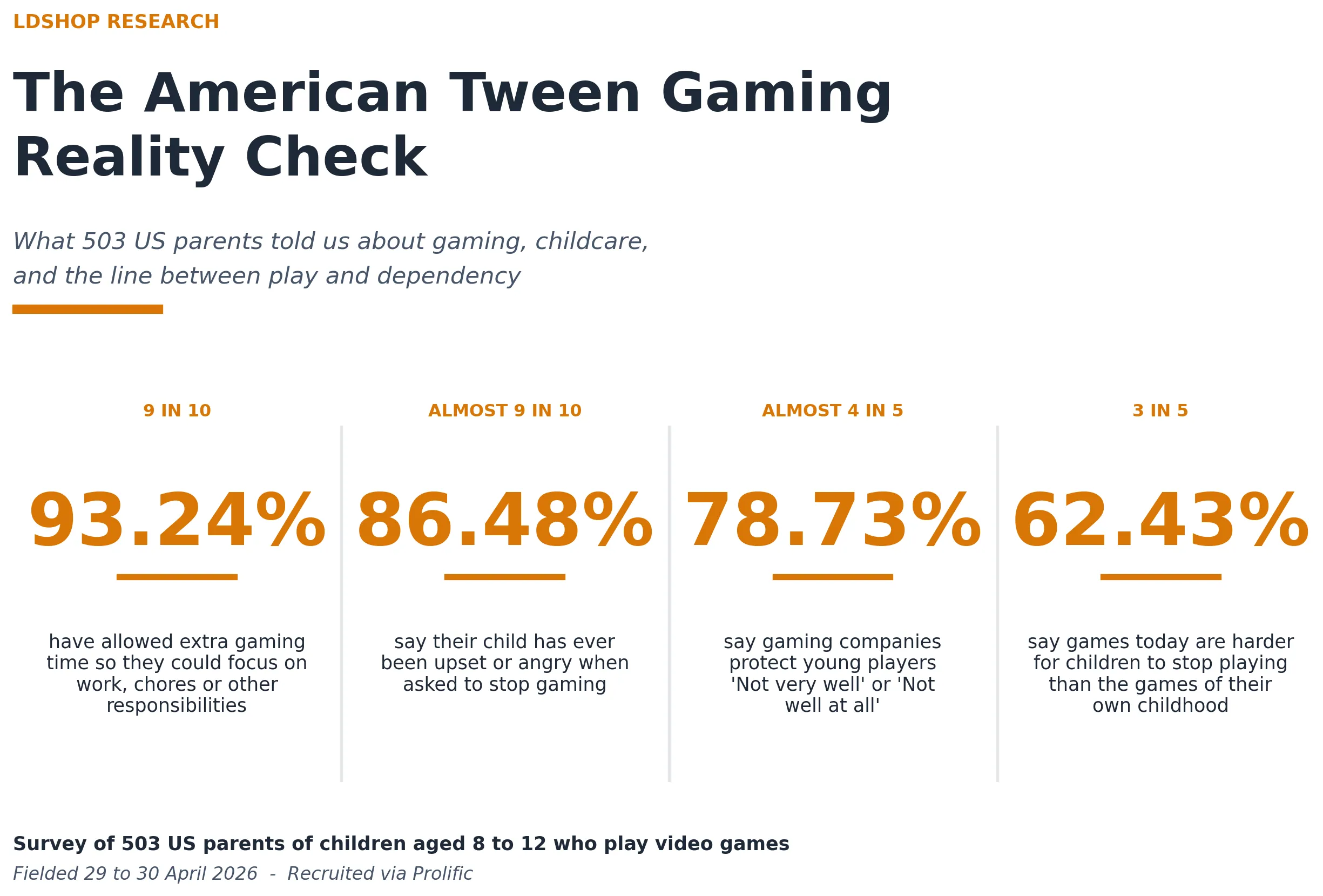
- 93.24% of US parents have used gaming as a way to buy themselves time. 71.17% do so sometimes or often.
- 46.67% of heavy-gaming households have caught their child playing an age-inappropriate game, versus 25.67% in light-gaming households.
- 78.73% say gaming companies protect young players poorly. Only 0.99% offer an unambiguous endorsement.
- Strict rules cut heavy play to 2.82%. No rules push it to 47.83%. Content exposure stays roughly the same either way.
- The most vigilant parents catch their child with an age-inappropriate game at 31.03%. The most hands-off, at 30.00%.
- 62.43% say today's games are harder to stop than the games of their own childhood.
- 54.67% would support a gaming career for their child, including 48.37% of parents who say the industry protects kids poorly.
- Black parents set stricter rules and monitor more, yet still report higher exposure to heavy play and age-inappropriate games than White parents.
Introduction
Four recent developments have changed the conversation around tween gaming in America. In January 2025, the Federal Trade Commission settled with the developer of Genshin Impact for $20 million and banned loot-box sales to under-16s without parental consent. In March 2026, House Republicans advanced a version of the Kids Online Safety Act that stripped out the duty-of-care provisions, the part of the bill that would have legally obligated platforms to protect children from harm. In April 2026, Nevada settled a state action against Roblox for $12.5 million over child-safety failures. And by May 2026, 148 child-safety lawsuits against Roblox had been grouped into federal multi-district litigation.
Each of these stories raises a question that policy alone cannot answer and this is why we surveyed 503 American parents of children aged 8 to 12 between 29 and 30 April 2026 to hear from inside the home.
We asked how long sessions run, what rules are in place, how households handle switching off, who their child plays with online, and what they think of the gaming industry today.
Who we asked
503 verified American parents of children aged 8 to 12 took part. Fieldwork ran on 29 and 30 April 2026 through the Prolific research panel. The breakdown:
|
Group |
Number of parents |
Share of sample |
|
Mothers |
358 |
71.17% |
|
Fathers |
143 |
28.43% |
|
Prefer not to say or not stated |
2 |
0.40% |
|
Aged under 35 |
94 |
18.69% |
|
Aged 35 to 44 |
278 |
55.27% |
|
Aged 45 and over |
131 |
26.04% |
|
White |
382 |
75.94% |
|
Black |
67 |
13.32% |
|
Asian |
17 |
3.38% |
|
Mixed |
17 |
3.38% |
|
Other or prefer not to say |
20 |
3.98% |
|
Full-time employed |
233 |
46.32% |
|
Part-time employed |
81 |
16.10% |
|
Not in paid work (homemaker, retired, etc.) |
87 |
17.30% |
|
Unemployed and job seeking |
47 |
9.34% |
Mothers are over-represented relative to fathers, which is typical of online parenting research and worth keeping in mind when reading the gender splits.
Findings for the smallest subgroups, with Asian and Mixed parents at 17 each in this sample, are described as indicative rather than precise estimates. The Black subgroup of 67 parents is large enough for firmer comparison.
PART I | HOW AND WHERE US TWEENS PLAY
Daily gaming time
We started with the most basic question. On a typical day, how long does the child play video games? The answers fall into a clear pattern, with a moderate middle and a heavier tail.
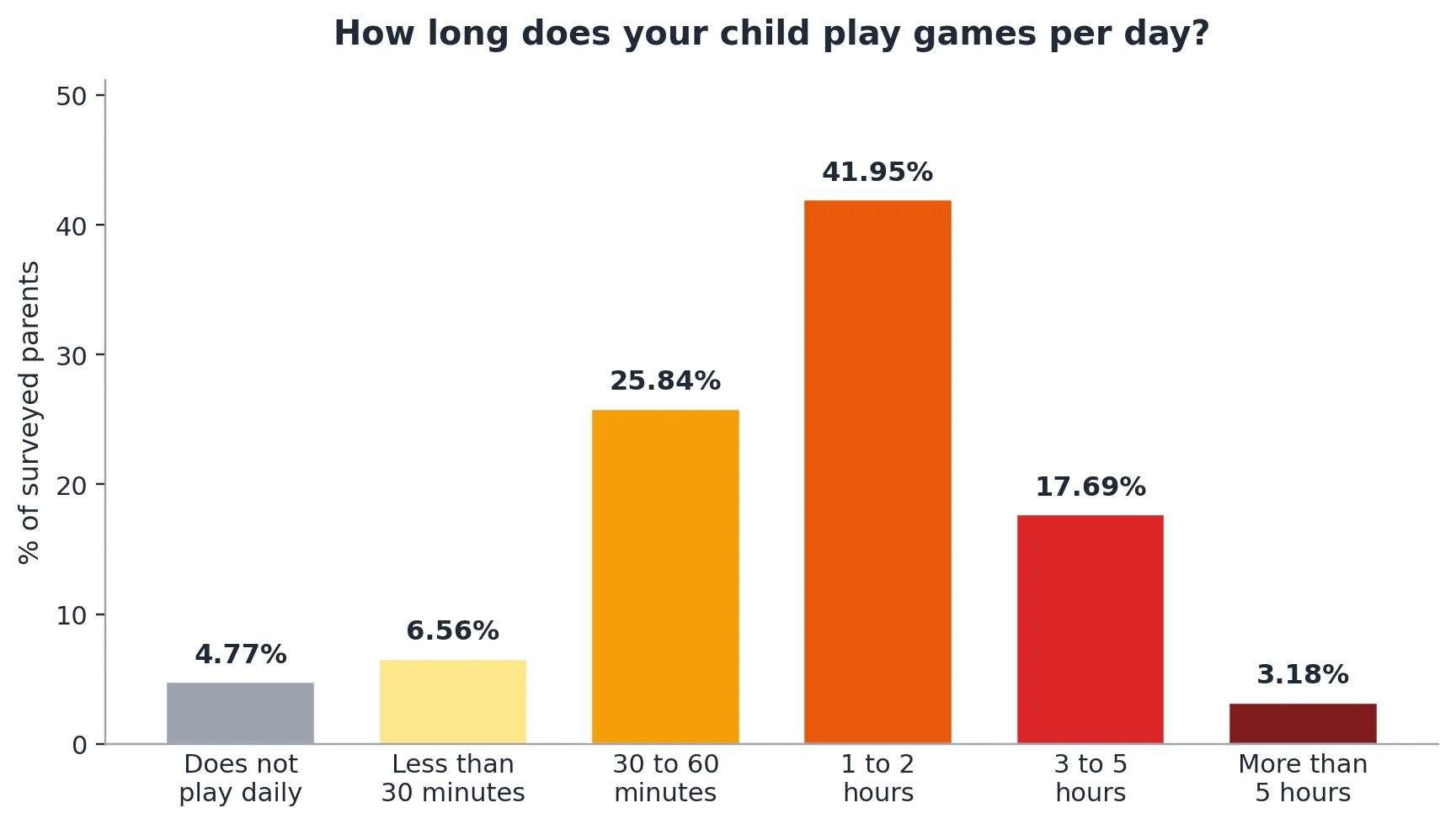
Daily gaming time, as reported by parents.
- 62.82% of US tweens play at least one hour every day. This is the modal experience.
- 20.87% play three or more hours a day.
- 3.18% play more than five hours a day.
Common Sense Media's Census of Media Use by Tweens and Teens has tracked total entertainment-screen time among US 8-to-12s rising from 4 hours 44 minutes a day in 2019 to 5 hours 33 minutes a day in 2021, with roughly 1 hour 26 minutes of that going to video games. Gaming sits in the middle of that picture and is the single largest sub-category for boys. Our 20.87% heavy-play band, at 3 or more hours of gaming on a typical day, sits squarely within the multi-hour daily range the American Academy of Pediatrics identifies as where physical activity, sleep, and schoolwork start to be displaced, a threshold the AAP flags as the concern range for school-age children, recommending consistent limits on recreational screen time even without a fixed numerical ceiling.
How long the child plays is only one part of the picture. What device they play on changes how much of that play a parent can actually see and monitor.
Primary device
The assumption that tween gaming happens in the living room on a console is no longer accurate for the majority. Tablet and mobile combined account for 37.38% of primary device use in this sample. American tweens are increasingly gaming on personal screens, in private spaces, which are often outside the line of sight of their parents.
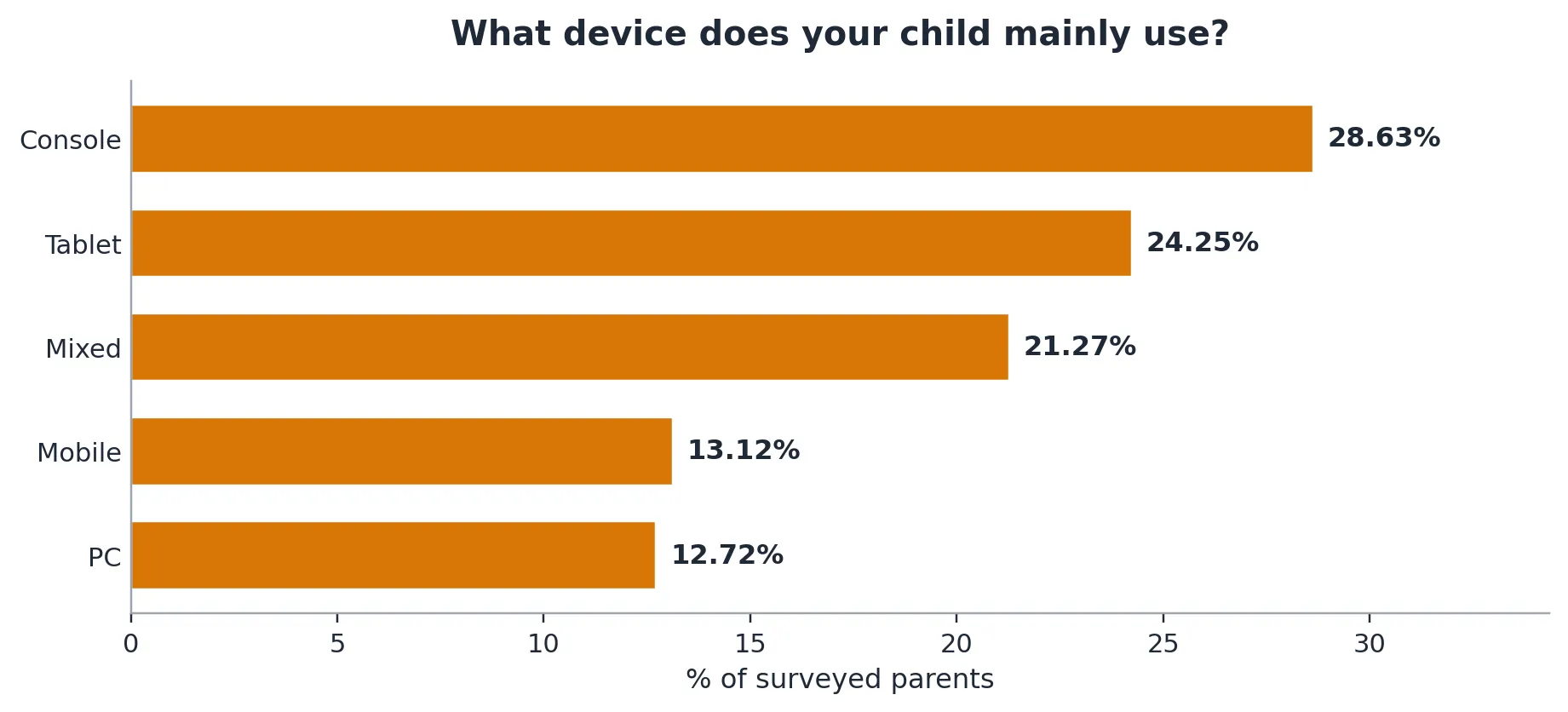
The primary device on which the child games.
However, console remains the largest single category at 28.63%, which means parents can still exercise control. But with tablet is right behind at 24.25% and that shows that children prefer their private space much more than the convenience of a console. Pew Research's recent work on teens has documented the same shift toward personal-screen gaming for older kids. Our data shows it arriving earlier, in the tween cohort, and it has consequences for how parental controls actually work. A control that runs on a console will not catch a child gaming on a tablet in their bedroom.
Across consoles, tablets, mobiles and PCs alike, the first lever parents reach for is setting rules at home.
PART II | HOW PARENTS TRY TO CONTROL GAMING
The rules households set
74.75% of American tween-gaming households have flexible rules. Only 14.12% have strict rules. Another 11.13% either have rules that are not enforced or have no rules at all.
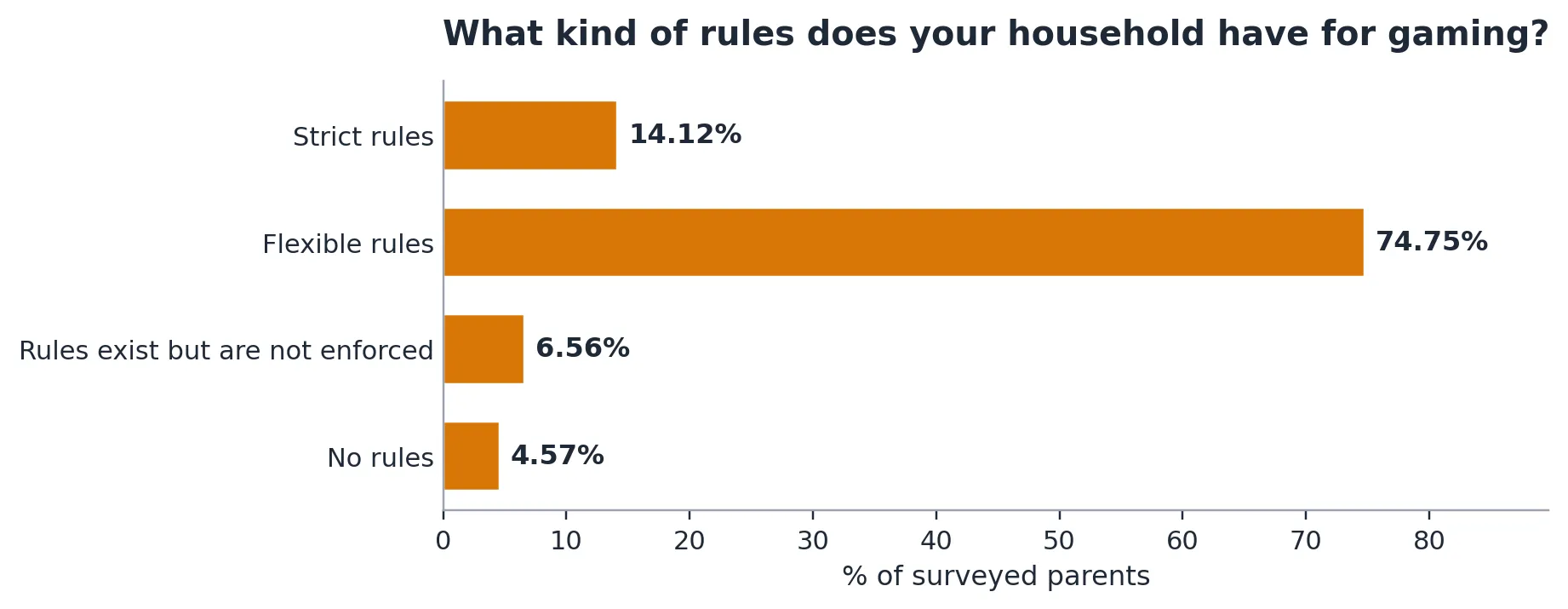
What kind of rules do you have around gaming?
Strict rules sharply reduce heavy play. Among the 71 households with strict rules, only 2.82% have a child who plays three or more hours daily. Among the 376 flexible-rule households, the figure is 21.01%. Among the 23 no-rules households, it is 47.83%. That is a 17-fold gap between the strictest and the most hands-off households on heavy-play prevalence, the clearest sign in this data that time rules actually work.
What strict rules do not do is prevent age-inappropriate content from reaching the child's screen. The rate at which parents have caught their child playing an age-inappropriate game runs at 35.21% under strict rules, 32.98% under flexible rules, 39.39% under unenforced rules, and 39.13% under no rules. Whatever rules parents are setting, they appear to keep spotting the unsuitable games at roughly the same rate.
Even when content controls seem hard enough to tackle, the survey points to a second problem being much harder to solve at home. Setting a rule is one half of household control. Watching what is actually being played is the other.
Active monitoring
91.05% of US parents say they always or sometimes monitor what their child plays, with 44.93% always and 46.12% sometimes.
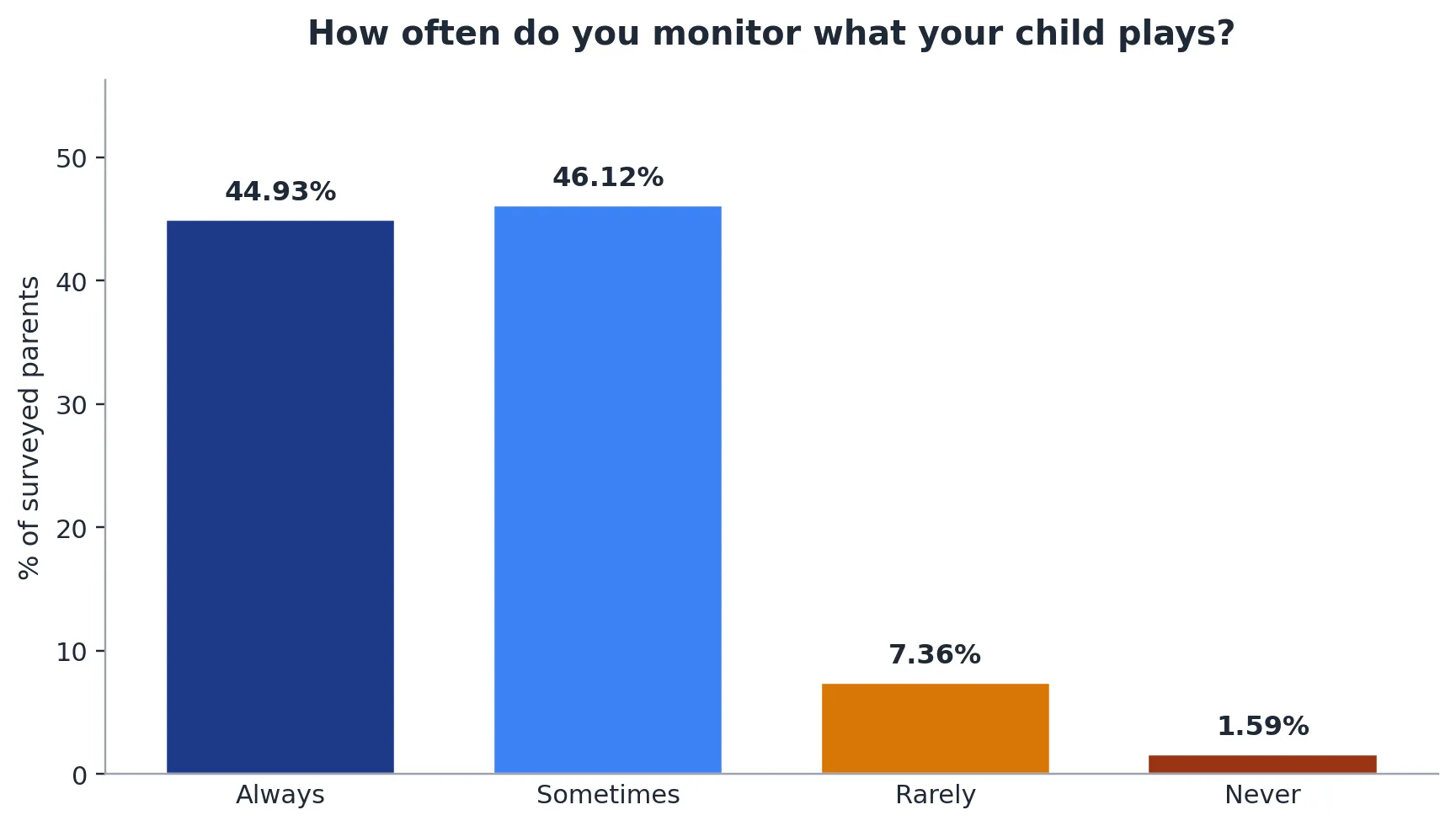
Do you actively monitor what games your child plays?
Pew Research has found that monitoring rises with parental concern, and that holds true in our data too. Households with heavy gamers monitor more closely than households with light gamers. Monitoring depends on a parent being present in the room, but software is what households lean on when no one is present.
Parental control software
45.53% of parents actively use parental control software. 25.45% have it set up but rarely check it. 26.44% do not use it. 1.99% say they do not know how.
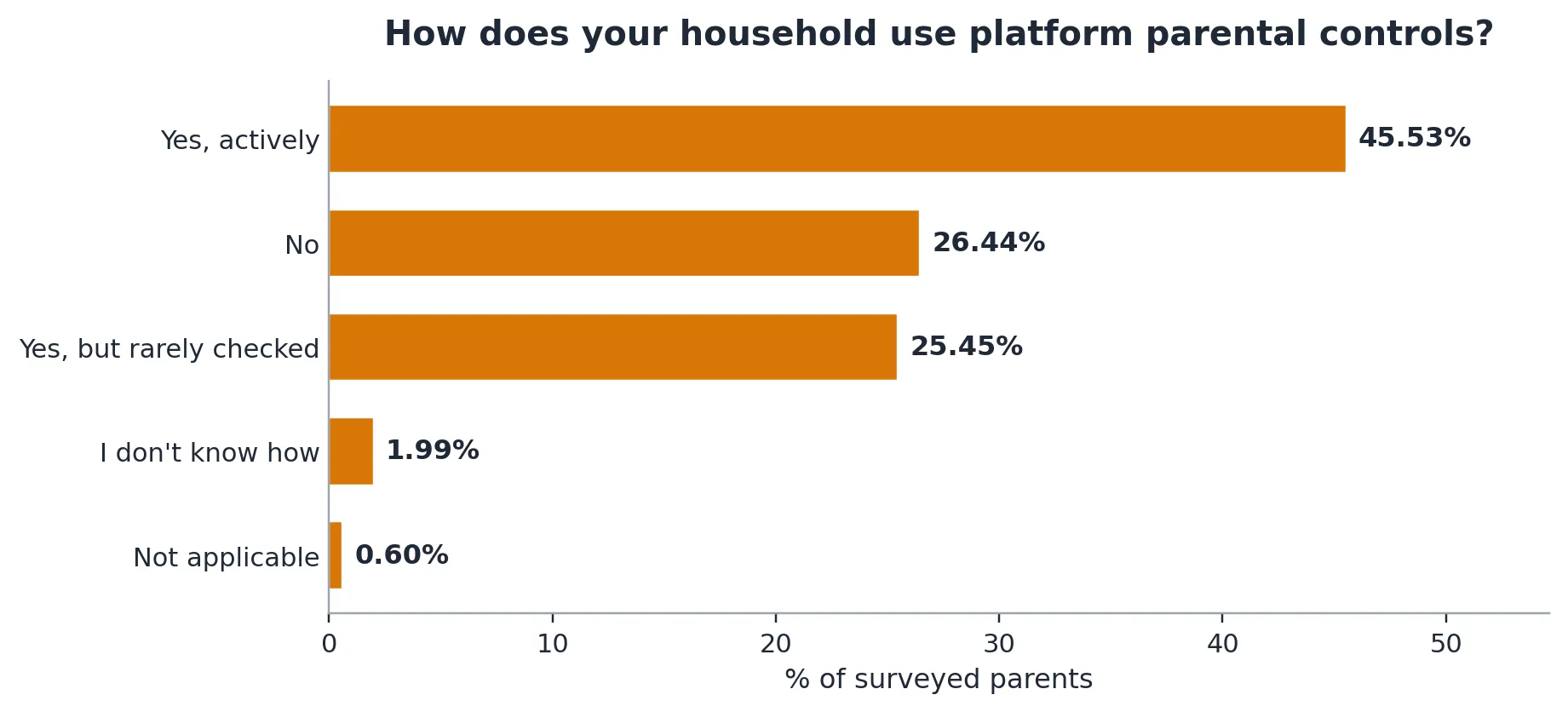
Do you use parental controls for gaming?
The 'do not know how' answer is small in absolute terms, but its existence after two decades of consumer education about parental controls is itself a signal. The Entertainment Software Association's 2025 Essential Facts publication reports around 86% of US gaming households now have parental controls in some form. Our combined 'actively' plus 'rarely checked' rate of 70.97% sits close to that range, with 26.44% of parents skipping the controls entirely.
Rules, monitoring and parental control software are typically pitched as a three-part toolkit that works together. The clearest way to see whether they do is to look at the households where all three are active at once, and the households where almost none of them are.
Most vigilant vs most hands-off
To check how well rules, monitoring and parental control software work in combination, we isolated three groups in the sample.
- 1. The most vigilant group is 29 parents who do all three: set strict rules, always monitor what their child plays, and actively use parental control software. These are parents pulling every lever the standard advice recommends.
- 2. The most hands-off group is 30 parents at the other end: those whose household rules are unenforced or do not exist, and who either do not use parental controls or do not know how to set them up. They are pulling almost no levers at all.
- 3. Everyone else, 444 parents, sits between those two endpoints. They have rules in some form, they monitor at least sometimes, and they have parental controls in some configuration, but not all three at full strength.
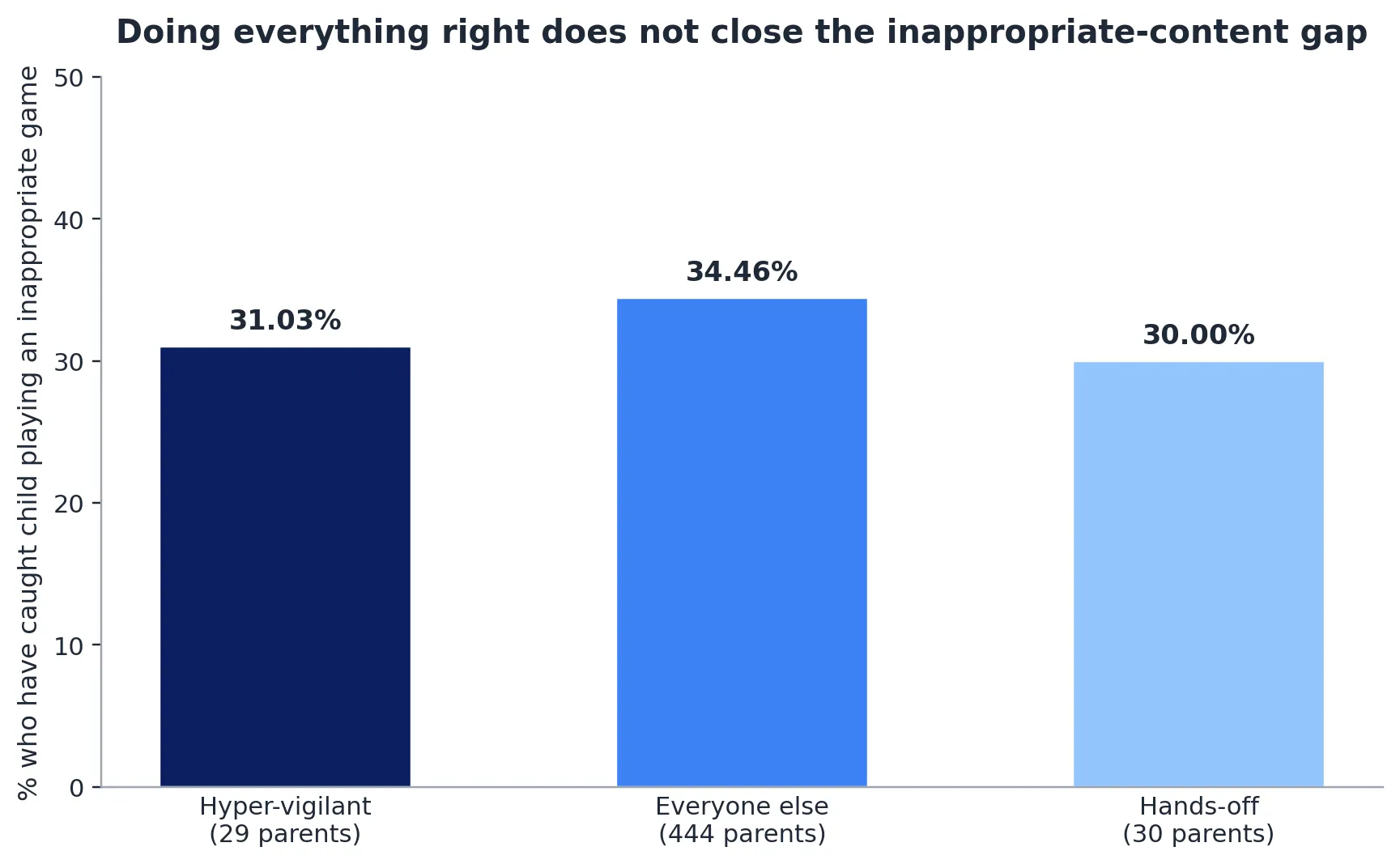
The most vigilant and the most hands-off parents catch their child playing inappropriate games at almost the same rate.
31.03% of the most vigilant group have caught their child playing an age-inappropriate game. Among the most hands-off, the figure is 30.00%. On this measure, doing everything right delivers essentially the same outcome as doing almost nothing. The most plausible reading is that the parental-controls industry is solving for the easier part of the problem, which is time, and not the harder part, which is content reaching the child's screen at all.
If the standard toolkit struggles to keep wrong games off children's screens, the obvious question is why households are allowing gaming so heavily. The answer is given in the upcoming section.
PART III | GAMING AS CHILDCARE AND WHAT FOLLOWS
Gaming as childcare
We asked parents whether they had ever allowed their child extra gaming time because they needed to focus on something else. The answer was almost everyone.
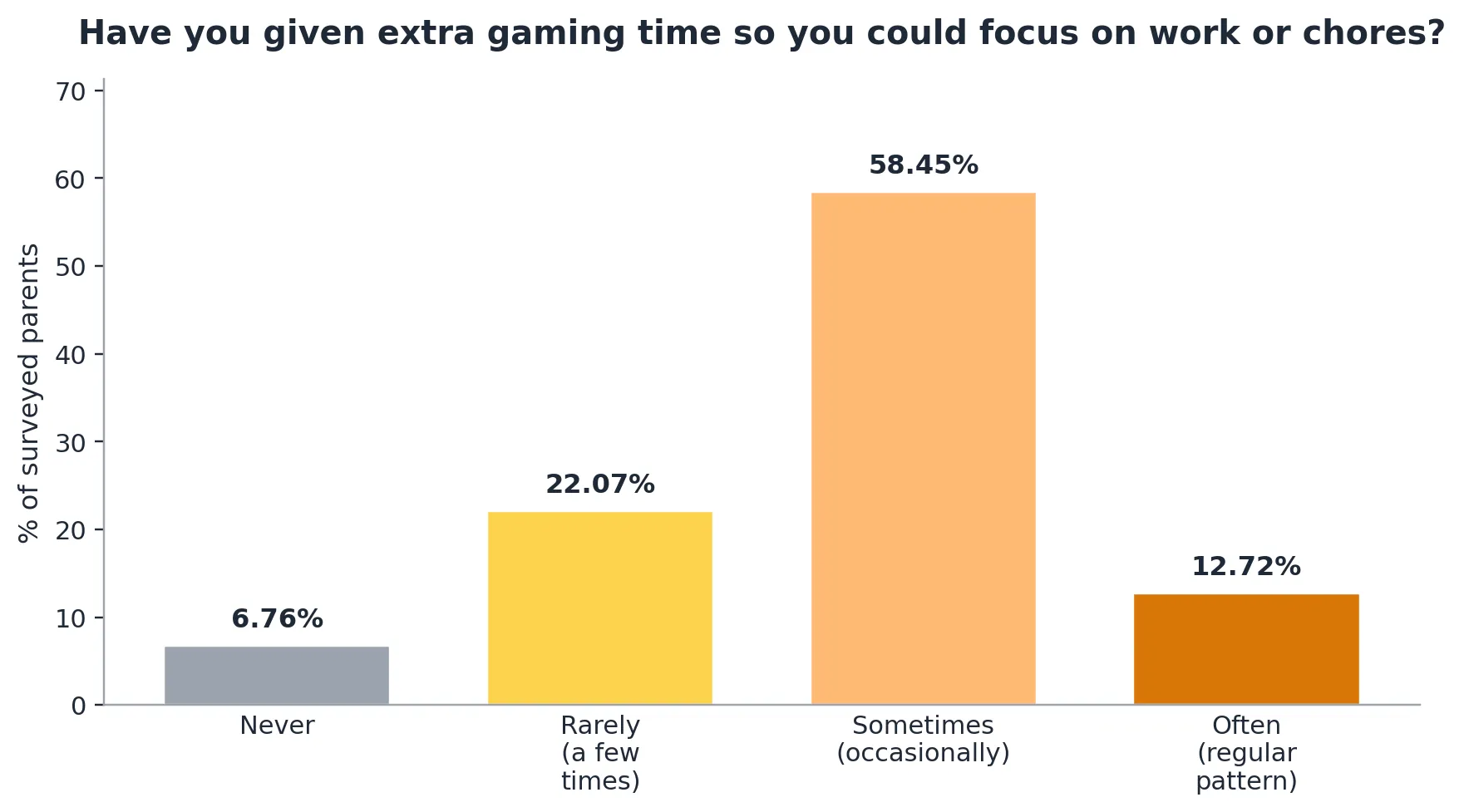
How often have you allowed extra gaming time so you could focus on work, chores or other responsibilities?
93.24% of American parents in this sample have used video games to buy themselves time at least once. 71.17% do it sometimes or often. 12.72% do it often. This is the most universal pattern in the survey, more common than having rules, more common than monitoring, more common than concern about any single outcome.
The closest comparison for parents using gaming as a tool to keep their children engaged is the Common Sense's finding that US tween entertainment screen time rose by close to an hour a day between 2019 and 2021, from 4 hours 44 minutes to 5 hours 33 minutes. Our data points to a specific household mechanism behind that rise which is that both kids and parents reach out to gaming.
However, using gaming is not free. The households that lean on it most often show a measurably different picture across the other questions in the survey.
What follows when gaming becomes childcare
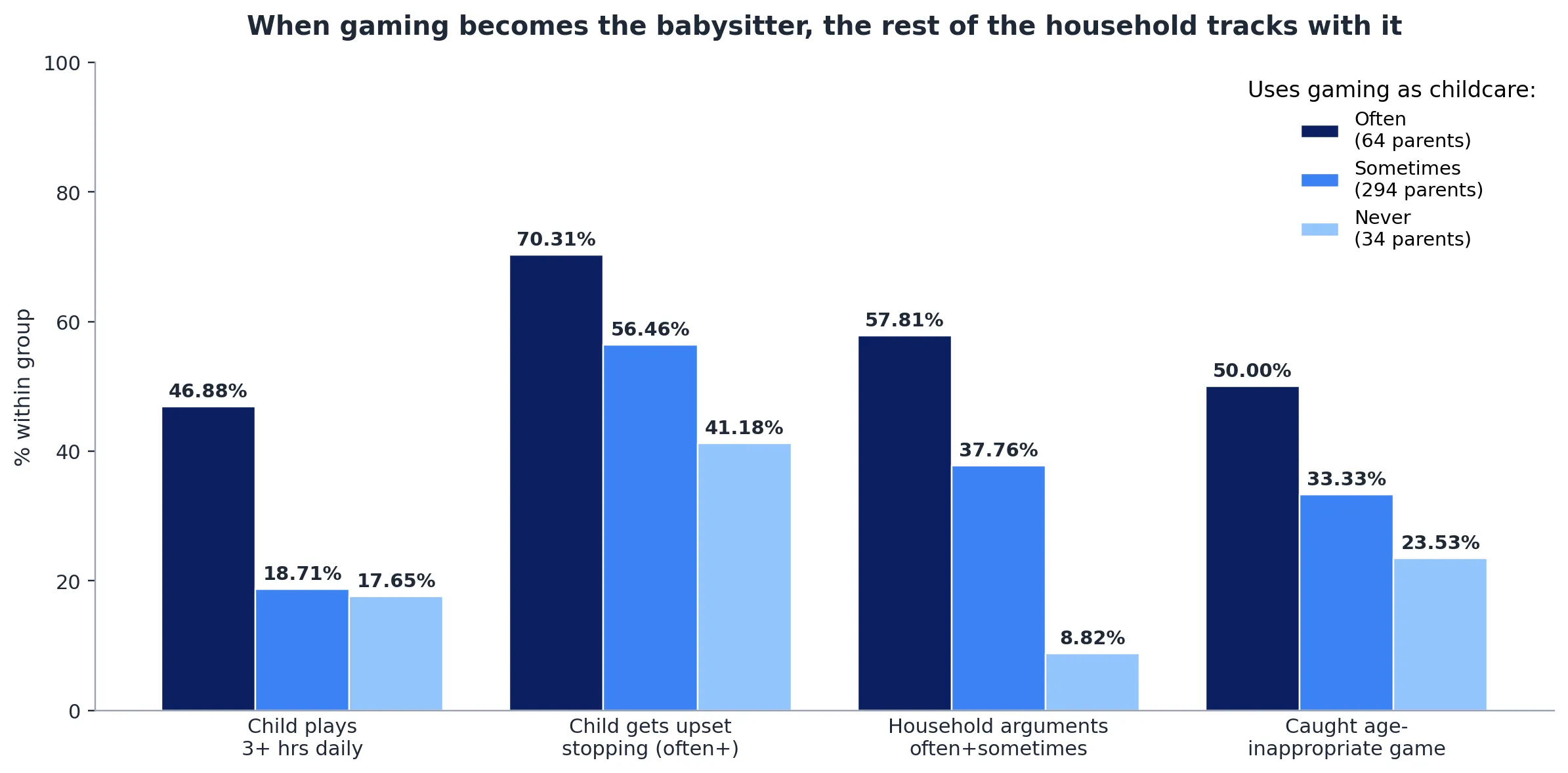
Each pair compares parents who use gaming as childcare often, sometimes or never.
Among the 64 parents who use gaming as childcare often, 46.88% have a heavy gamer at home. 70.31% have a child who gets upset when asked to stop. 57.81% report frequent arguments about gaming, and 50.00% have caught their child playing a game that is not for children. The parents who never lean on gaming as a childcare substitute report 17.65%, 41.18%, 8.82%, and 23.53% on the same four measures.
This is not a story of bad parenting but cutting corners to run a household on a budget. This is quantified by Care.com's annual Cost of Care report, which has tracked US childcare costs rising faster than wages every year into 2026, with weekly daycare averaging around $321 and a nanny averaging around $766. Moreover, the Bureau of Labor Statistics employment data continues to show employers maintaining productivity expectations for remote and hybrid work, and since household labor still falls primarily on mothers, they desperately look for a way out and gaming happens to bridge the gap, affordably. However, the data points to a cost attached to this seemingly simple solution. Longer play sessions hamper children's education and in many cases leads to household conflict. What's more, there's a sharp rise at the chances of children encountering games they are not meant to play or even see
Of all the moments inside a tween gaming household, the friction is most concentrated when a parent asks the child to stop.
Reactions when asked to stop
86.48% of US tweens become upset occasionally when their parent asks them to stop gaming. 13.72% do so often.
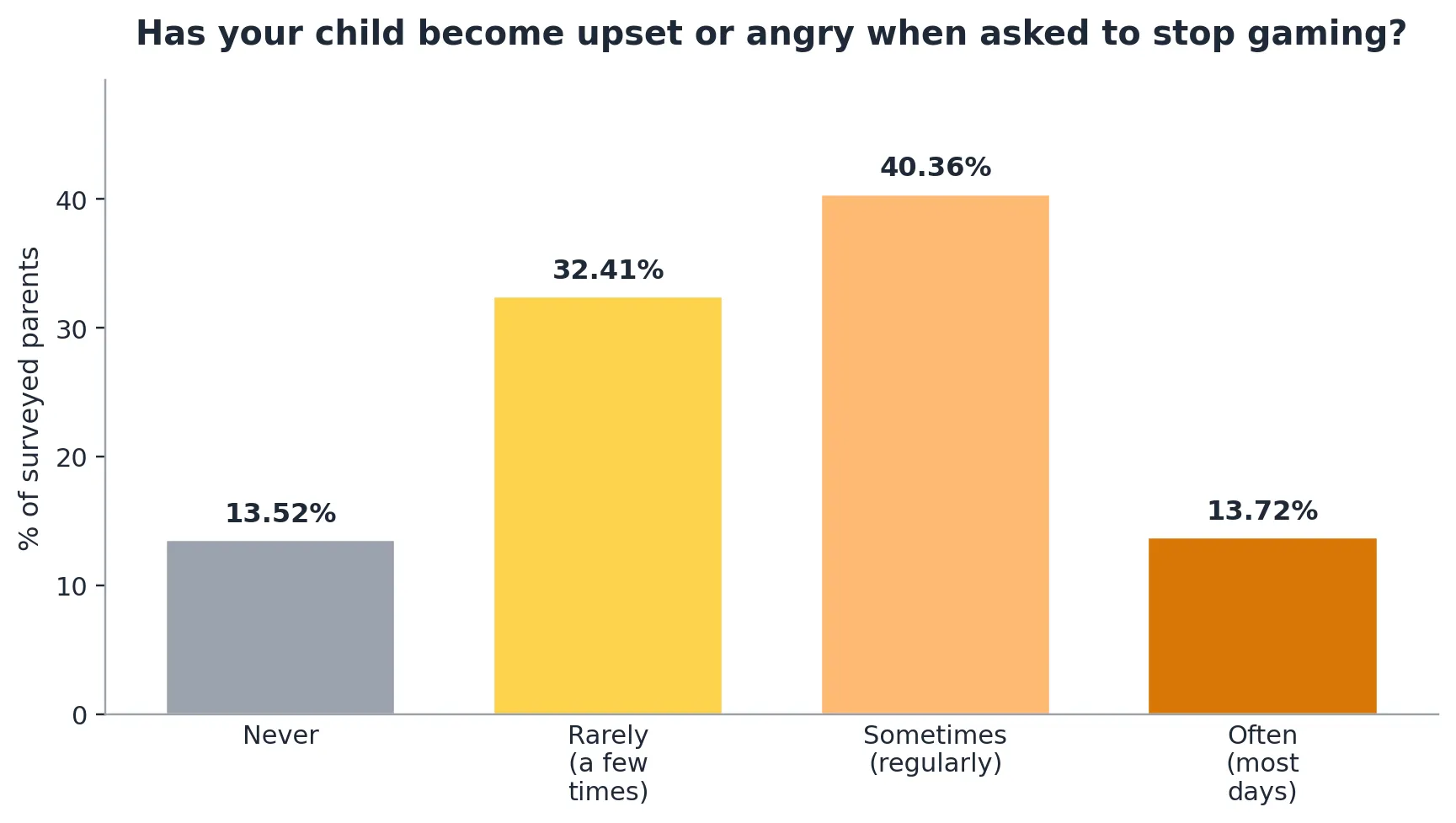
Has your child ever become upset or angry when asked to stop gaming?
Gaming is not an activity that children put down at will. The data shows a cluster larger than that estimate at the angry-stopping end. 13.72% of the children get upset often when asked to stop, and 72.46% of those 69 children would be very upset if they lost gaming for a week.
Asking a child to end a single session is a test of how attached they are to gaming. Asking parents to imagine their children a full week without it is a harder one, and the answers point in the same direction.
Parents opinions on a week without gaming
When we asked parents how their child would react to a full week without games, only 8 of the 503 predicted their child would be relieved.
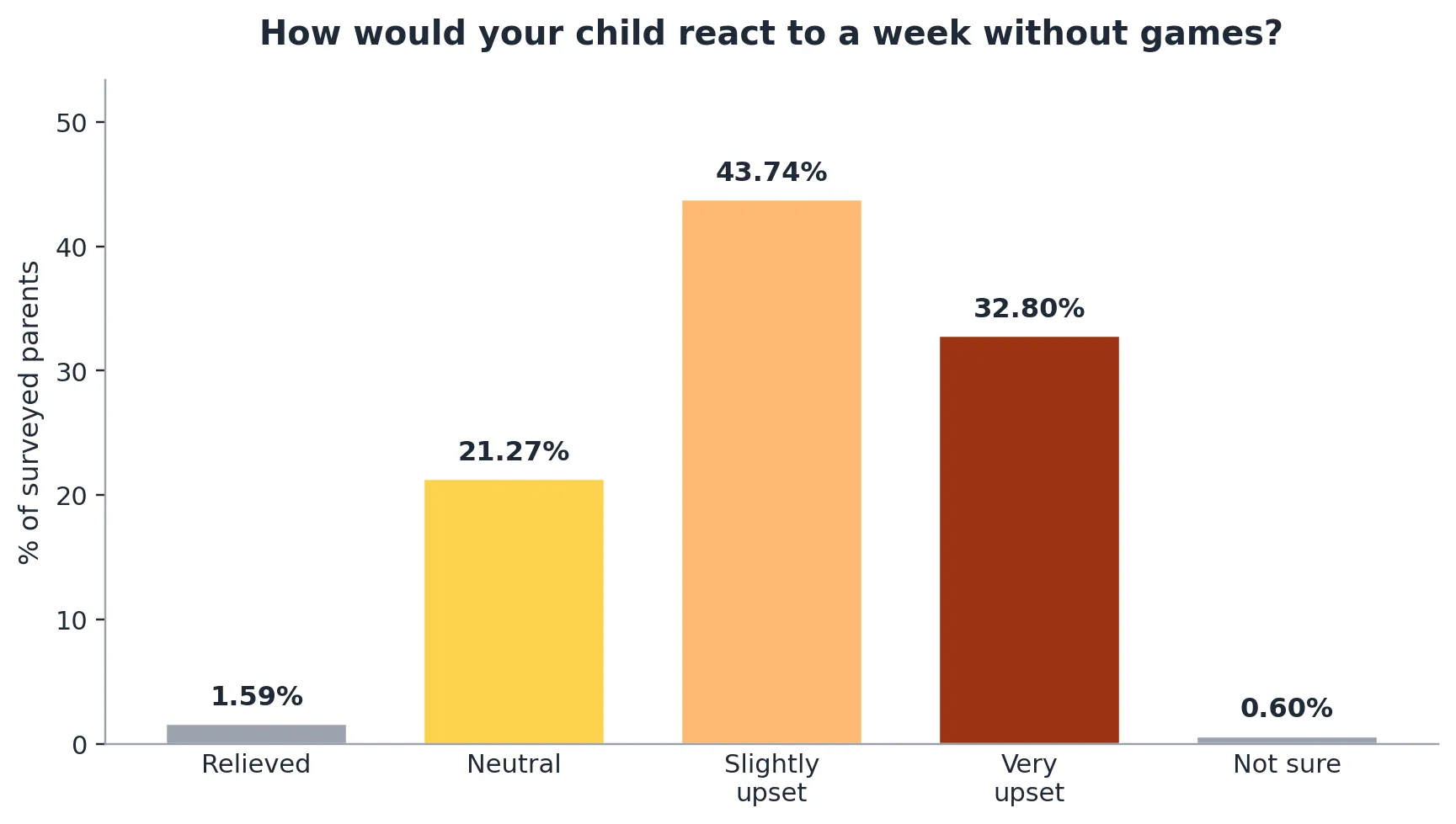
How would your child react to one full week without games?
Three-quarters of surveyed parents predicted some level of upset. About a third predicted their child would be very upset. Only a small minority predicted relief or a neutral reaction. The heavy-play tail is where the predicted reaction is sharpest. Among parents of heavy gamers, the very-upset figure climbs to 54.29%. Among parents of light gamers, it is 15.51%. The 38.78% gap between the two groups is the single sharpest contrast in the dataset, and it tracks the design economics of modern games: daily streaks, battle passes, time-limited offers, and friend cohorts that play on a schedule.
When children react so strongly to losing gaming for a week, switching off becomes a recurring friction point in the household.
Arguments about gaming
19.09% of US tween-gaming households never argue about gaming. 45.33% argue rarely, 29.42% argue sometimes, and 6.16% argue often.
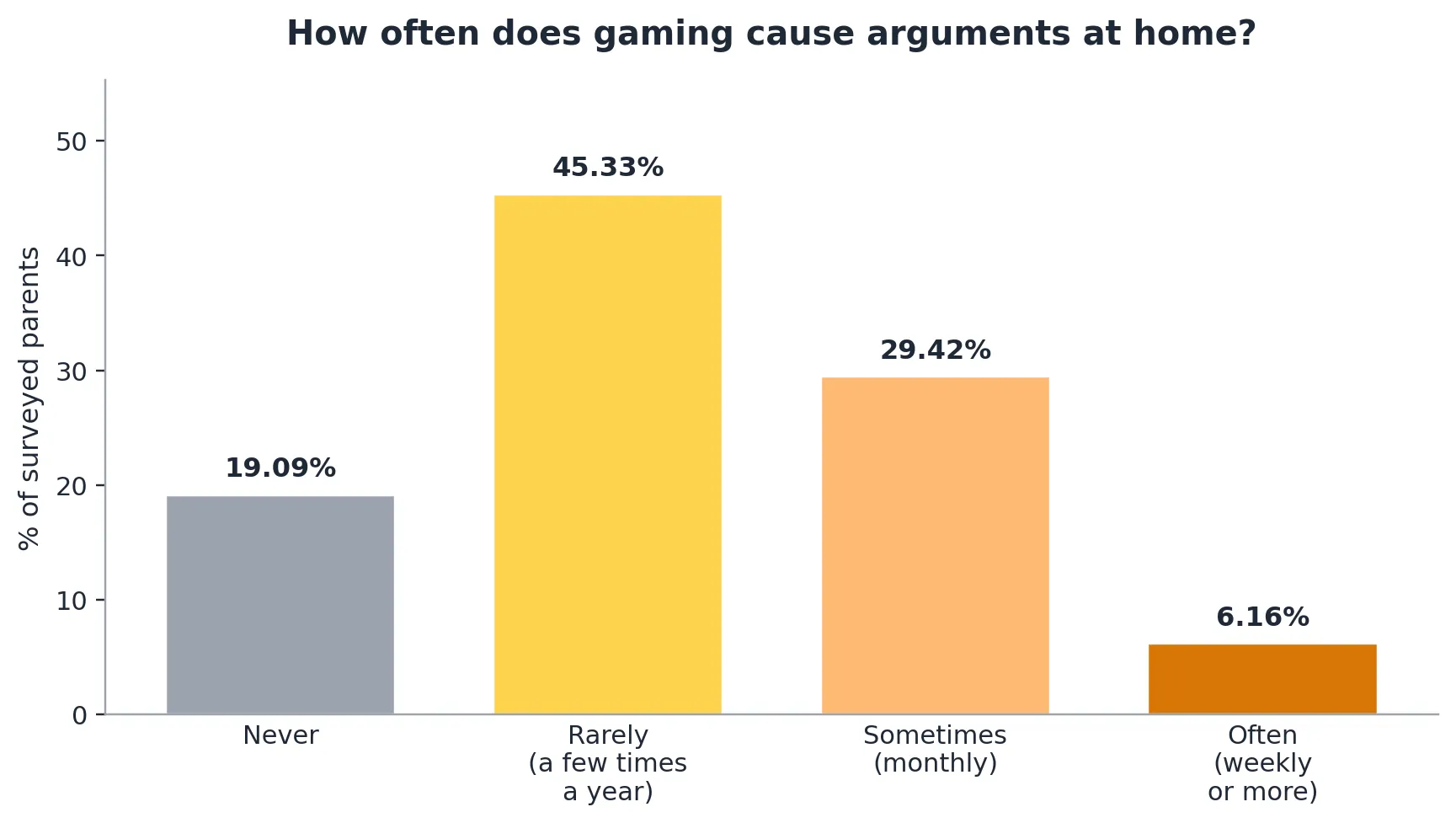
How often does gaming cause arguments in your household?
The single largest gap in argument rates is by how often the household uses gaming as childcare. Among the parents who use gaming as childcare often, the argument rate climbs to 57.81%, whereas for the parents who never depend on gaming as a childcare tool, the rate drops to 8.82%. That is a 48.99% gap on a single behavioral measure and, the cleanest signal that the convenience of using a console as a babysitter has a household-conflict price tag attached to it.
Yet conflict is just one side of the coin. While in some households gaming is a bone of contention, it is also the primary way for many children to connect with their friends.
PART IV | ONLINE PLAY AND FRIENDSHIPS
Gaming and friendships
Just over half of US parents say gaming helps their child stay connected with friends somewhat or a lot, at 52.09%. Almost no one says gaming is irrelevant to their child's social life. For better and for worse, multiplayer games are doing what suburban backyards and after-school programs used to do.
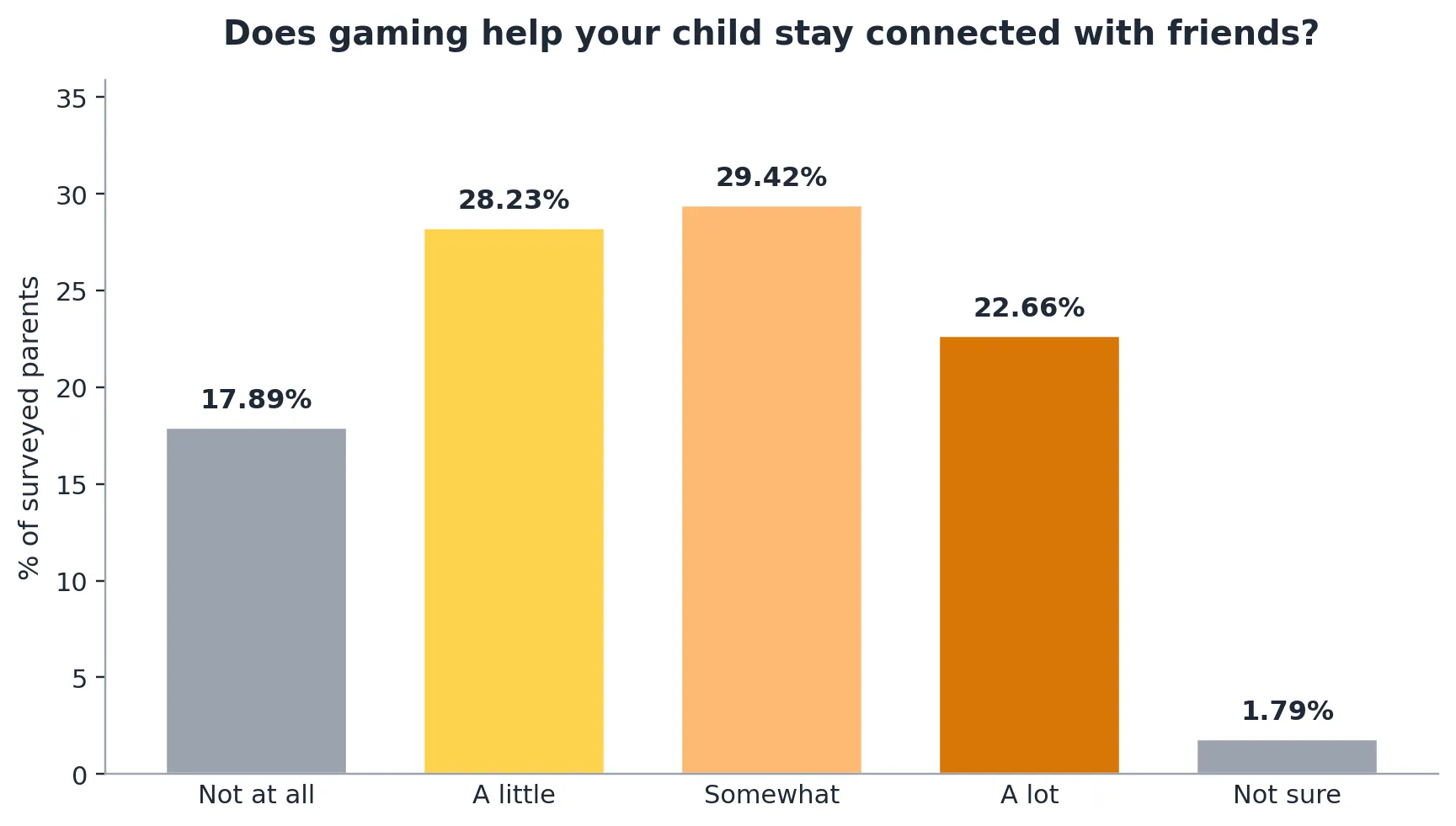
To what extent does gaming help your child stay connected with friends?
Pew Research's 2024 study on teens and technology found that 84% of US teens say video games help them connect with friends, and 80% of US teens play games on smartphones. Our tween figure, at 52.09% of parents saying gaming connects their child 'somewhat' or 'a lot,' is lower in absolute terms but tracks the same direction. Among heavy-gamer households, the share of parents saying gaming connects their child socially 'a lot' jumps from 22.66% to 36.19%. The same online friends a tween is connecting with are also the people their parents most worry about not knowing.
Concern about online interactions
60.64% of all parents are at least somewhat concerned about who their child interacts with online while gaming, with 25.65% very concerned and 34.99% somewhat concerned.
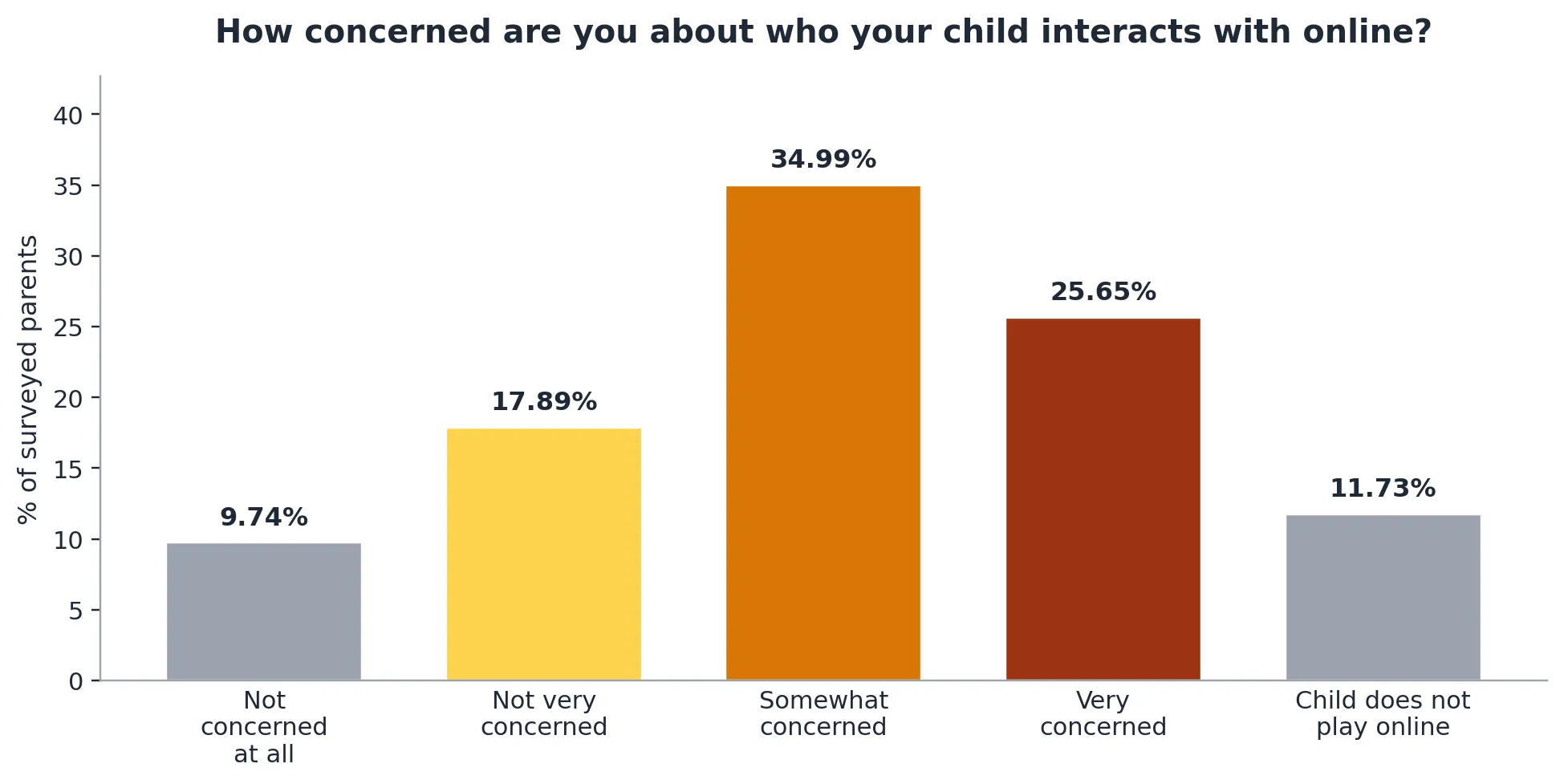
Are you concerned about who your child interacts with while gaming online?
If we remove the 11.73% of households where the child does not play online at all, the share of remaining parents who are at least somewhat concerned rises to 68.69%. Mobile-gaming households are the most concerned at 71.21%, with console households the least concerned at 55.56%. The pattern fits: mobile play happens on personal screens in private spaces, where parental visibility is lowest.
That concern has a legal backdrop behind it. By May 2026, 148 Roblox child-safety cases had been grouped into federal multi-district litigation. Texas and Nevada have pursued state-level action. Roblox launched facial age estimation verification for in-app chat in early 2026.
While concern about their children’s online friends is a major worry for American parents, age-inappropriate games, in-game spending, physical activity, sleep and schoolwork are the others, and together they make up the rest of this report.
PART V | WHAT WORRIES AMERICAN PARENTS
Age-inappropriate games
34.00% of American parents at some point, have discovered their child playing a game they felt was inappropriate for their age.
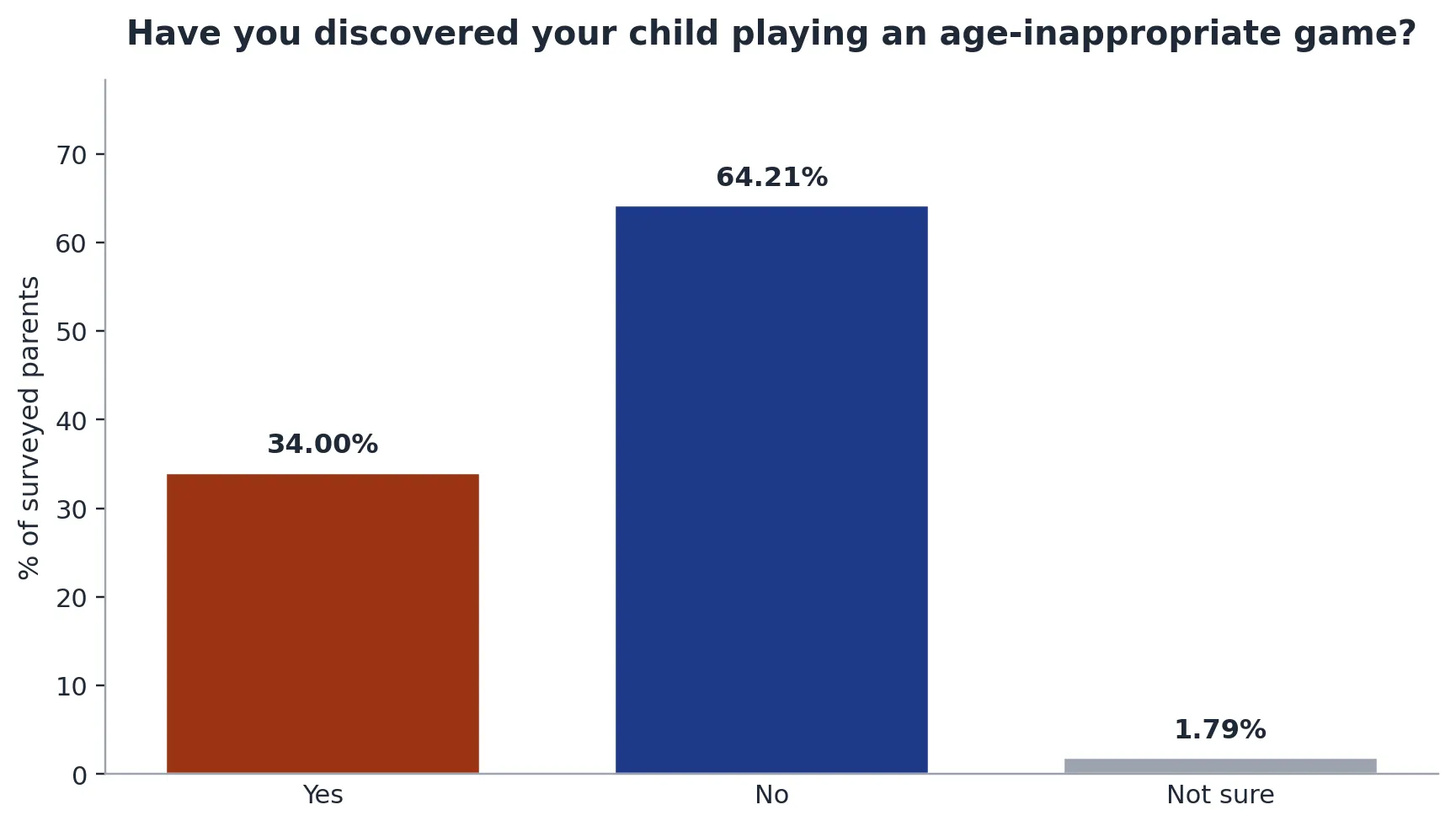
Have you ever discovered your child playing a game you felt was inappropriate for their age?
This is the most common direct-encounter problem parents report in the survey. It is also dependent on daily play time, climbing steeply as the child's session length grows.
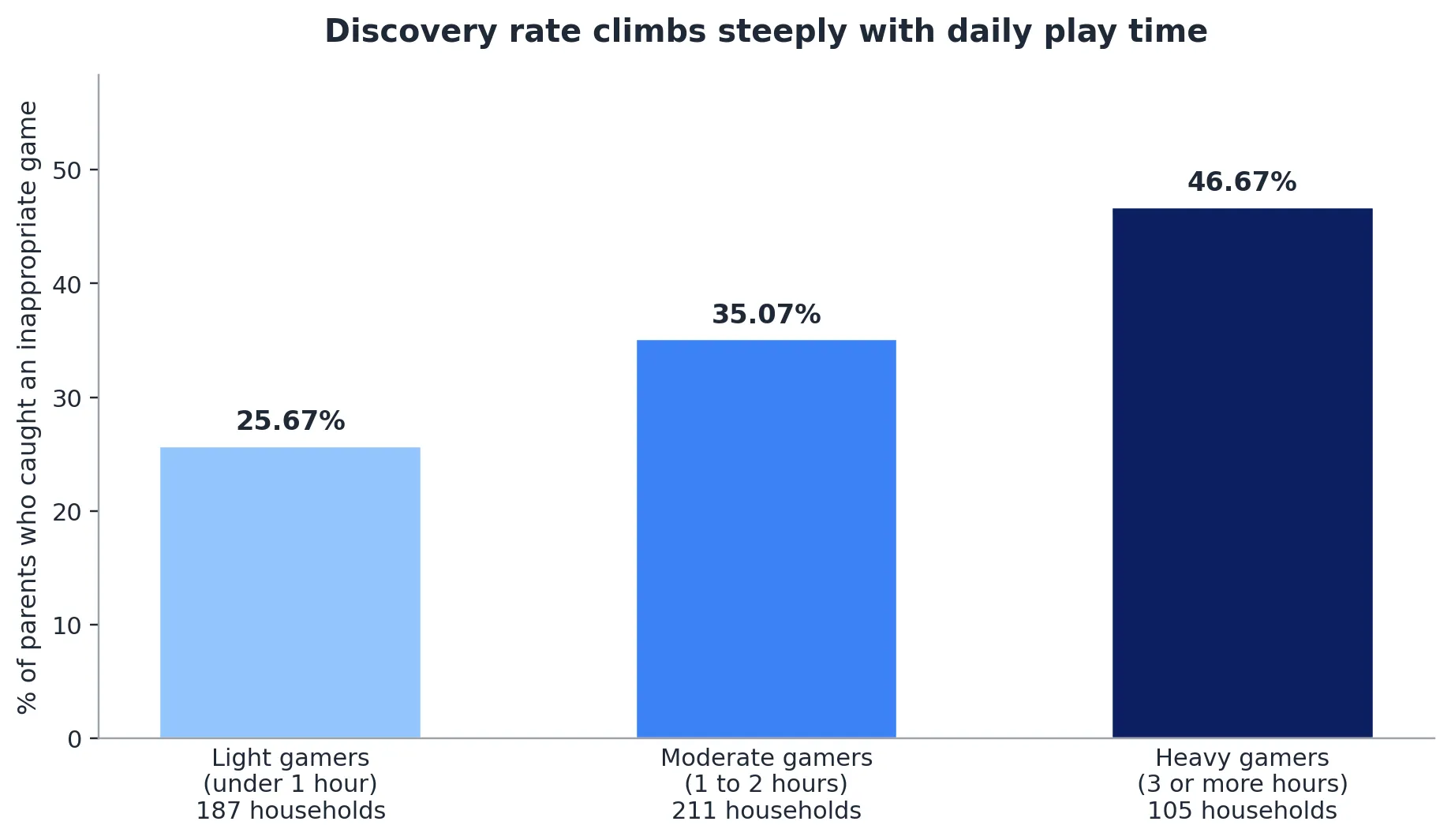
Share of parents who have caught their child playing an age-inappropriate game, by how long the child plays daily.
Light-gaming households (under 1 hour daily) report that they have spotted age-appropriate games 25.67% times. Moderate-gaming households (1 to 2 hours) report 35.07%, whereas heavy-gaming households (3 or more hours) report 46.67%. The 21.00% gap between the heaviest and lightest gamers is one of the cleanest patterns. The same gradient appears when we sort households by how often parents use gaming as childcare. Parents who never use it that way report a 23.53% rate of having caught their child with a game that is not meant for children. Parents who do so sometimes report 33.33%, and parents who do so often report 50.00%. The more gaming is acting as the household babysitter, the more likely the parent is to lose track of what is being played, and inside those same games, there is real money moving too.
In-game purchases
31.01% of tween households report that the child does not make in-game purchases at all. Among the 68.99% where the child does, almost everyone is concerned. 'Pressure to spend' is the single biggest worry, edging out overspending.
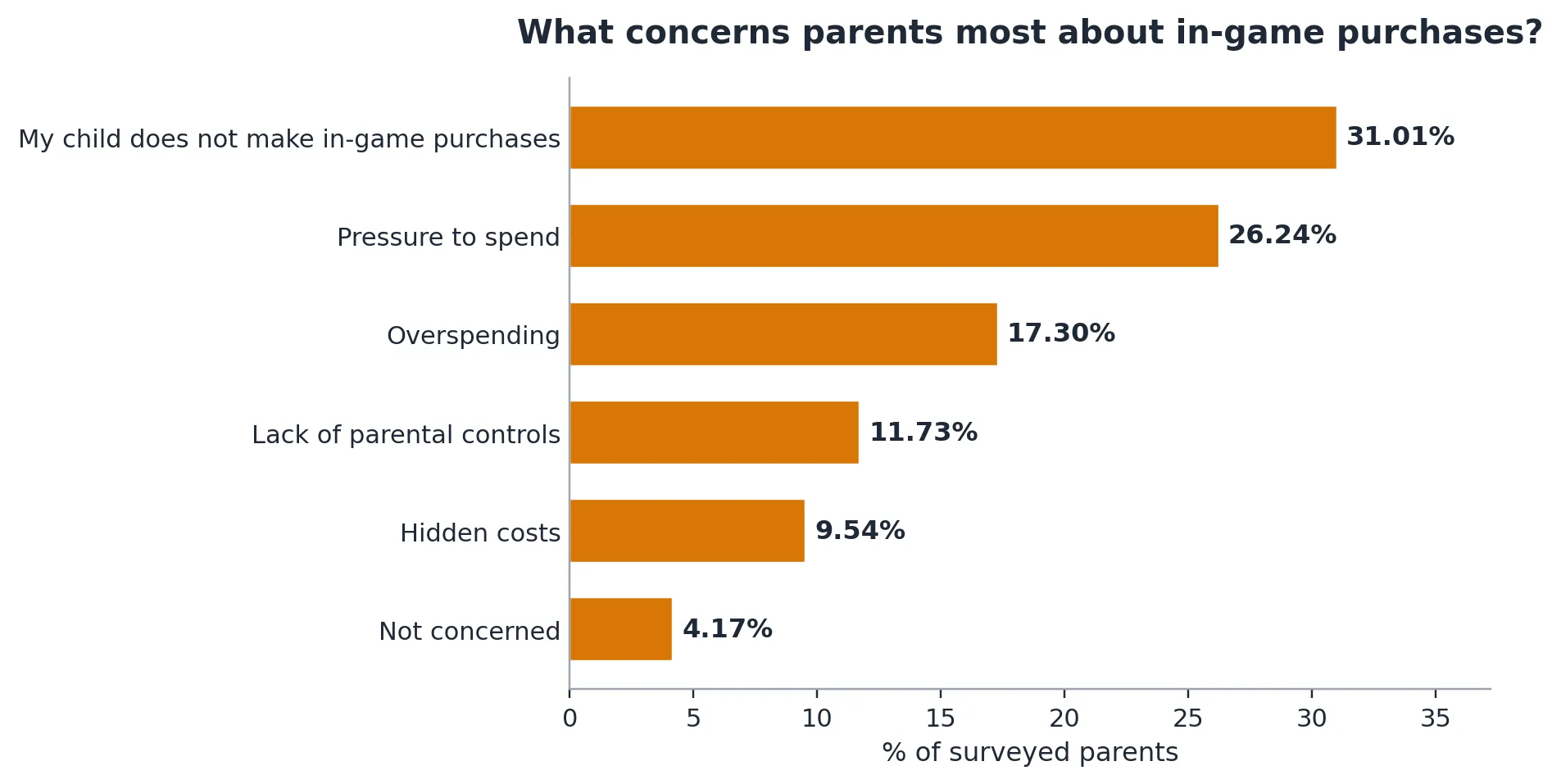
What concerns parents most about in-game purchases.
Pressure-to-spend mechanics cover loot boxes, time-limited offers, friend-cohort notifications, and the dark patterns the FTC named in its January 2025 settlement with the developer of Genshin Impact. That settlement was the first major federal enforcement action against loot-box mechanics aimed at children, and it banned their sale to under-16s without parental consent. The worry has shifted upstream from overspending to the design pressure that produces the spending in the first place. Only 4.17% of all parents said they were not concerned at all about in-game purchases.
Inappropriate games and in-game spending are the concerns parents run into directly, but behind those sit quieter, slower worries about what hours of daily gaming is doing to their child's body, sleep, and schoolwork.
Welfare concerns: Physical activity, sleep and schoolwork
We asked parents about three welfare areas: sleep, physical activity, and schoolwork. Physical activity is the top concern, sleep is next, and schoolwork is the lowest of the three.
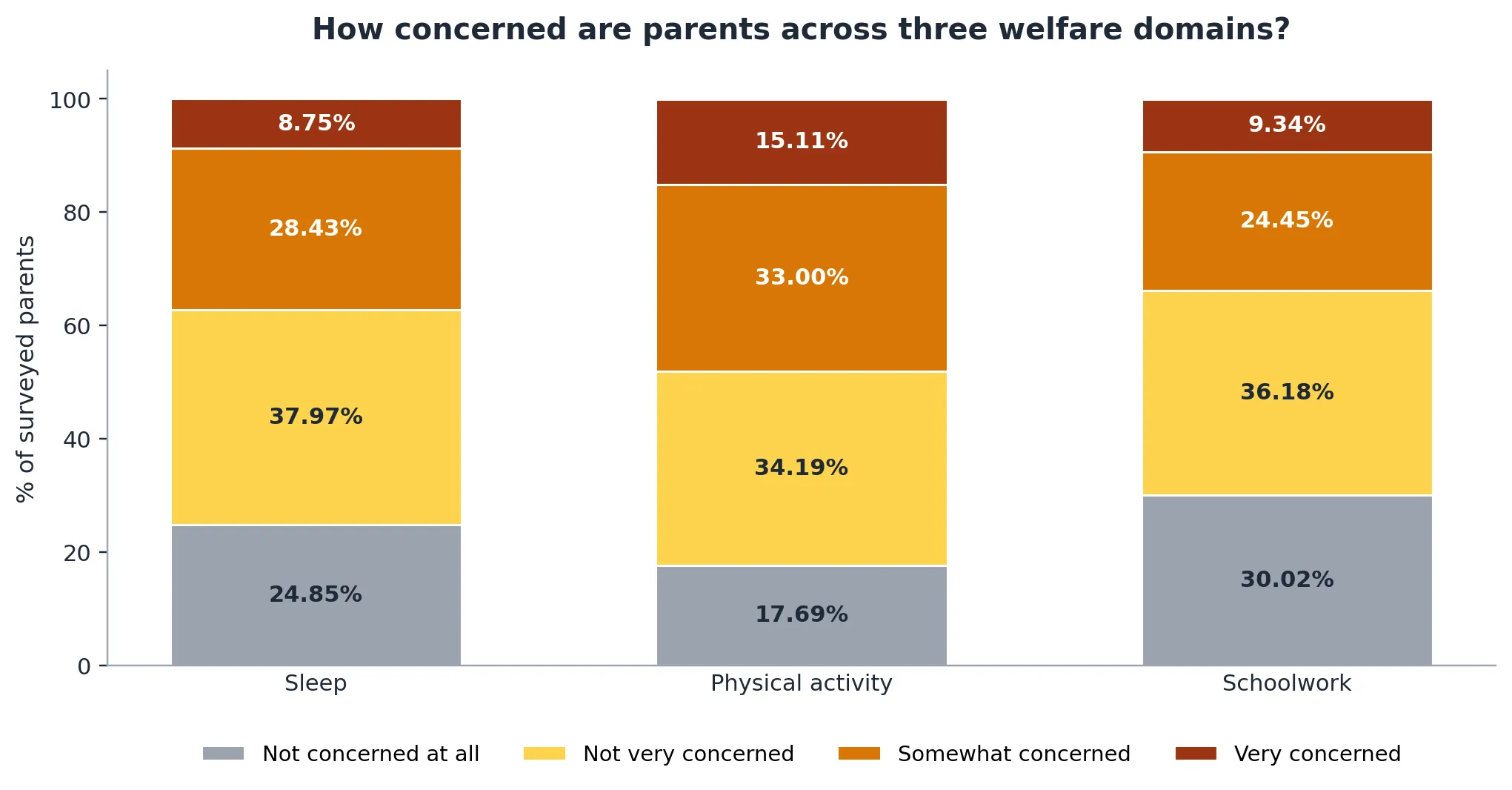
How concerned parents are across three welfare domains, stacked to 100%.
Physical activity: 48.11% of parents are somewhat or very concerned. The single highest concern category in this section.
Sleep: 37.18% are somewhat or very concerned.
Schoolwork: 33.80% are somewhat or very concerned.
That order of the worries among parents in itself is a finding. American parents in 2026 are more worried about their child sitting still too long than about their grades or their sleep schedule. Physical activity tops the list because it is the most visible thing for a parent to see: a child sitting in front of a screen for hours is an inactive child. The CDC's physical activity guideline for children aged 6 to 17 is 60 minutes a day, and 20.87% of parents in the survey had a child exceeding these limits by three or more hours of games on top of school and other screens. Sleep is somewhere parents have an obvious lever in bedtime, which keeps that worry more contained. Schoolwork concern sits lowest of the three because parents are reporting their child's school performance is strong overall, by their own assessment.
School performance
79.52% of parents in this sample rate their child's school performance as Excellent or Good. Only 2.39% describe their child as below average or struggling.
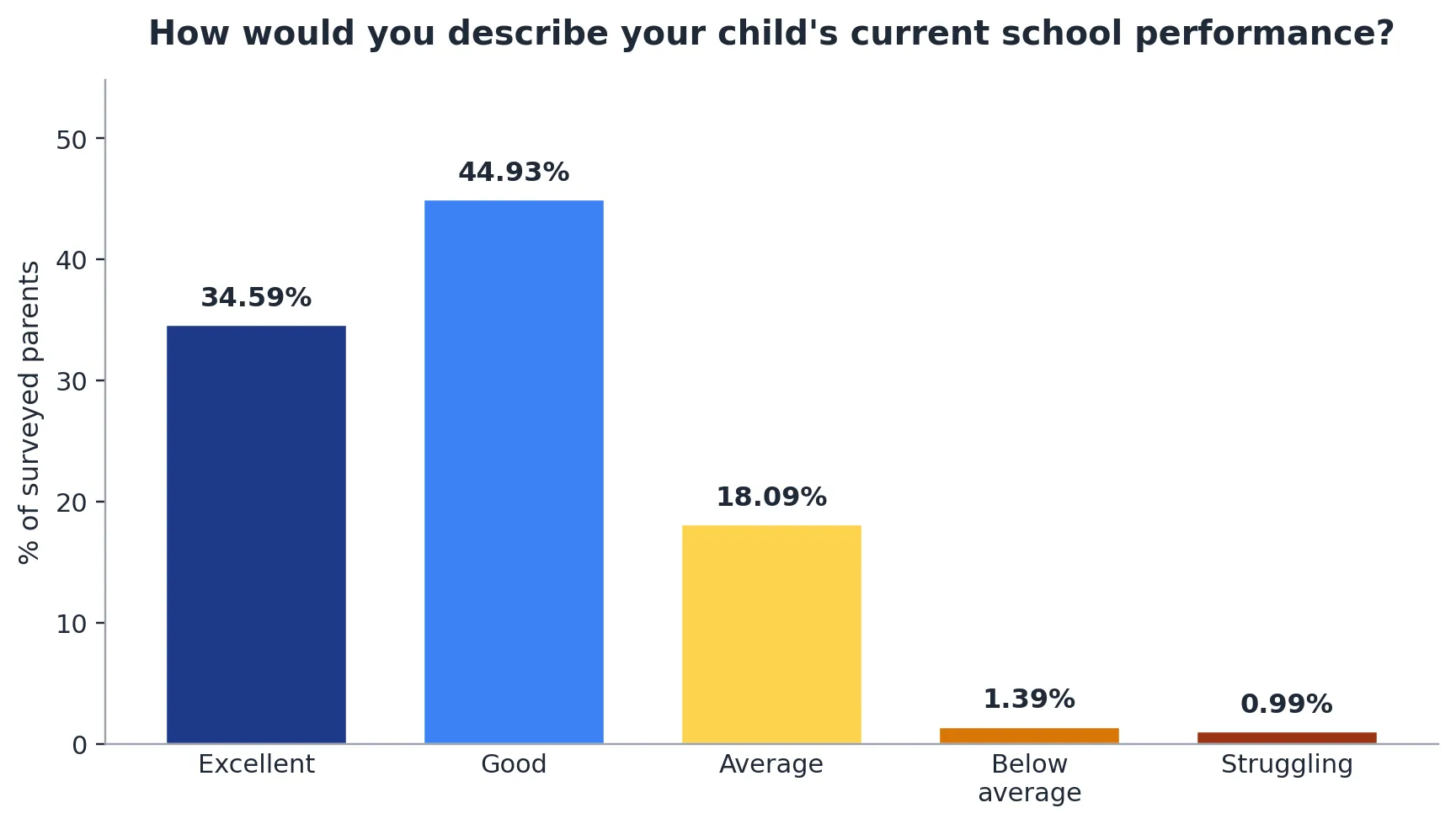
How parents describe their child's current school performance.
Whatever pressure gaming is putting on this generation, it is not, on average, showing up yet in their parents' assessment of grades. The exception sits at the heavy-play tail. The share rated Excellent drops from 43.32% among light gamers to 23.81% among heavy gamers. That drop only appears at the extreme end of play time, not across the middle. The mass of American tween gamers is still doing well in class.
Parents worried on all three counts
21.47% of US parents in this sample are concerned about sleep, physical activity, and schoolwork at the same time. The 199 parents not concerned about any of the three sit at the other end.
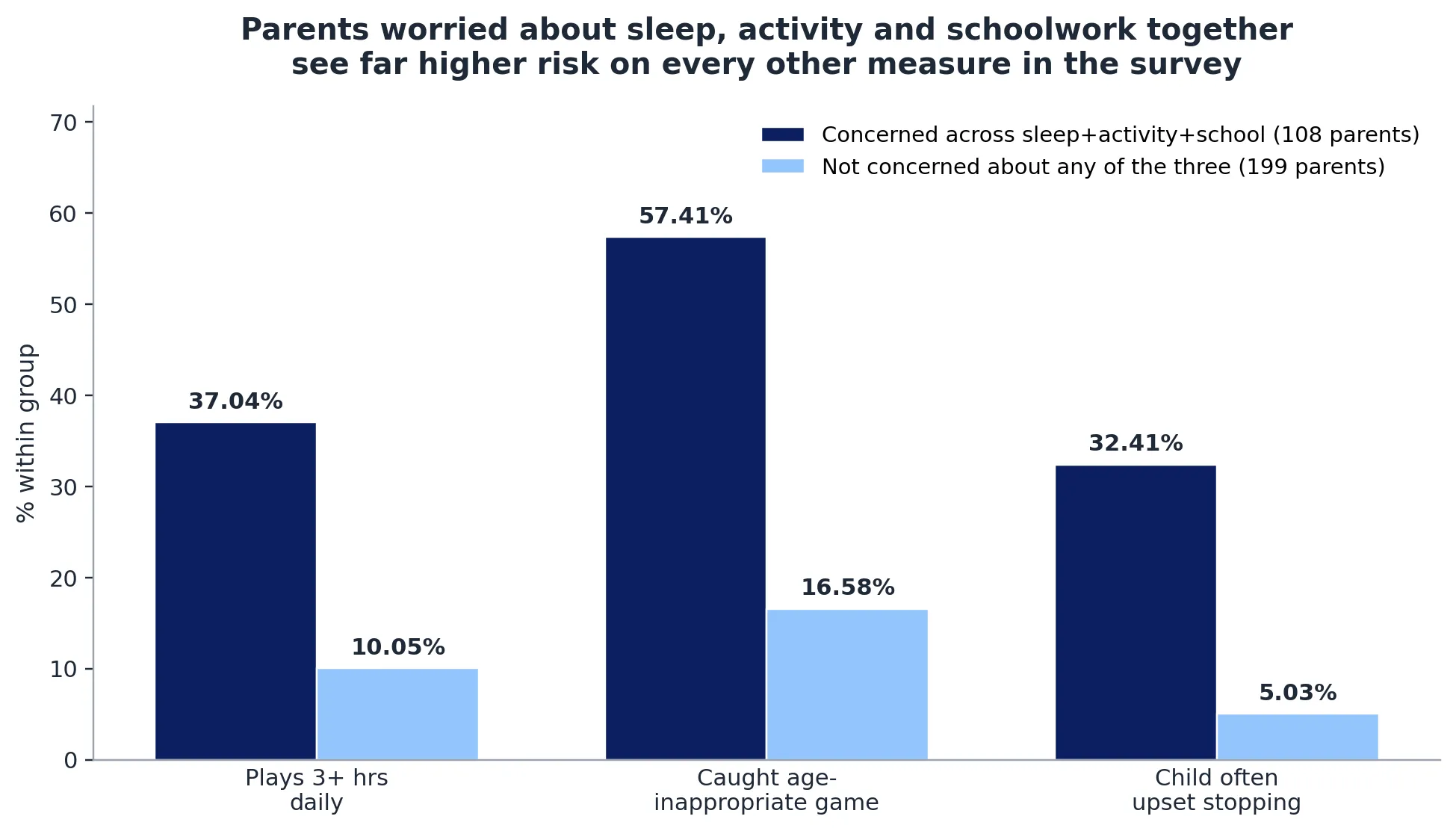
The 21.47% of parents worried across all three welfare measures are catching age-inappropriate games at about 3.46 times the rate of the unworried.
Inside the triple-concerned group, 57.41% have caught their child with an age-inappropriate game. In the not-concerned group, the figure is 16.58%. The 40.83% gap is the cleanest signal in the data that the parents who worry the most are right to be worrying. The triple-concerned cluster is not paranoid, they are seeing more than the unconcerned majority is, and that gap shows up just as sharply when the data is cut by how long a child plays each day.
PART VI | WHERE THE STRAIN FALLS HARDEST
Heavy gamers vs light gamers
The clearest stratification in this data is by daily play time. The 105 households where the child plays three or more hours a day look measurably different from the 187 where the child plays less than an hour. The gap shows up on every measure we cut by.
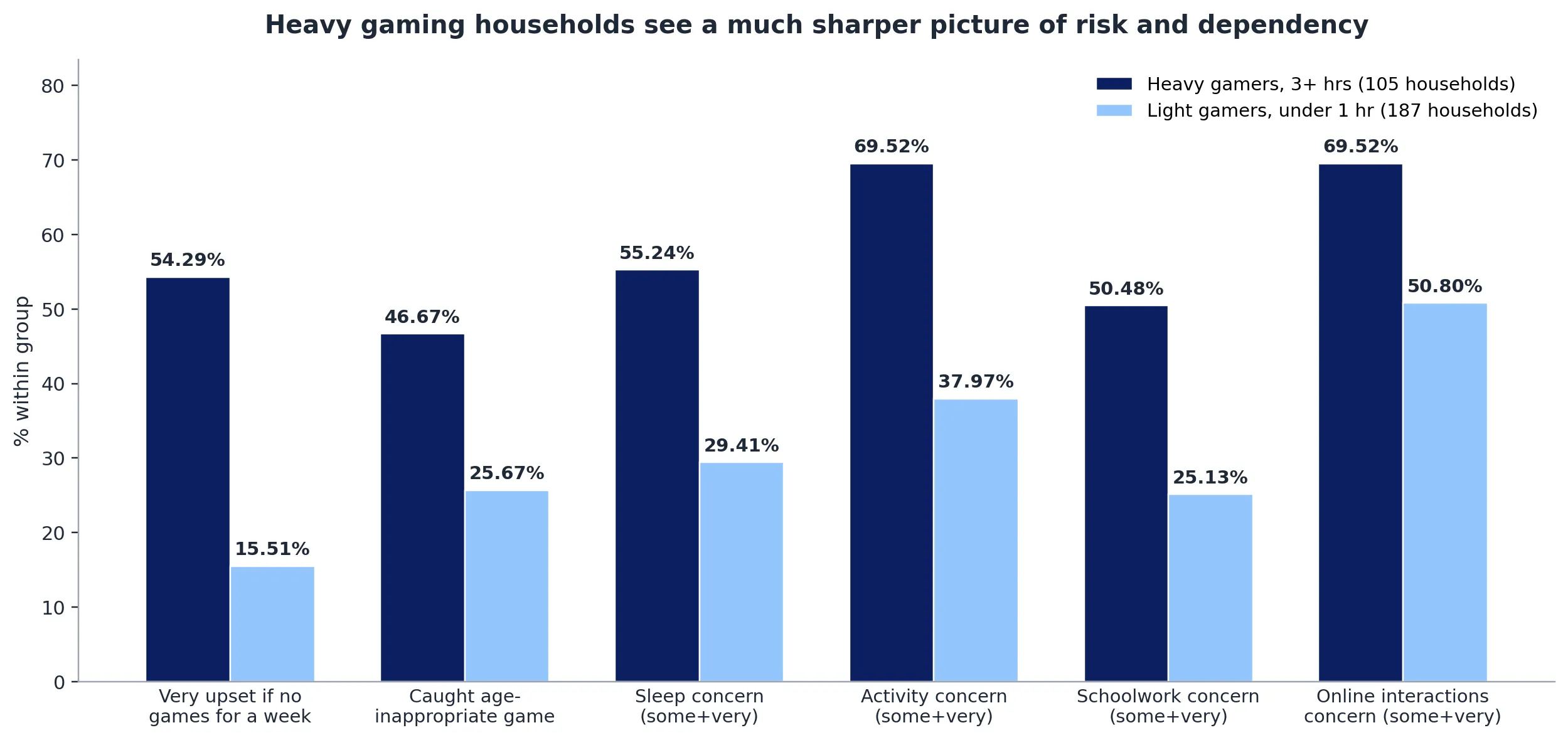
Across six measures, the 105 heaviest-gaming households see a much sharper picture of risk than the 187 lightest-gaming ones.
Parents with heavy-gaming children are more than twice as likely to predict their child would be very upset without games for a week, at 54.29% versus 15.51%. They are nearly twice as likely to have caught their child with an age-inappropriate game, at 46.67% versus 25.67%. Their concern about physical activity is 69.52% versus 37.97%, followed by schoolwork concern at 50.48% versus 25.13%, sleep concern at 55.24% versus 29.41%, and finally online-interaction concern at 69.52% versus 50.80%.
Heavy-gaming households are also far more likely to say gaming helps their child connect socially. More play means more connection, but it also means more concern across every other domain. That balance, though, varies depending on the household ethnicity as well.
Black parents: More vigilant, more exposed
The 67 Black parents in our sample appear to be walking into a harder version of the same environment.
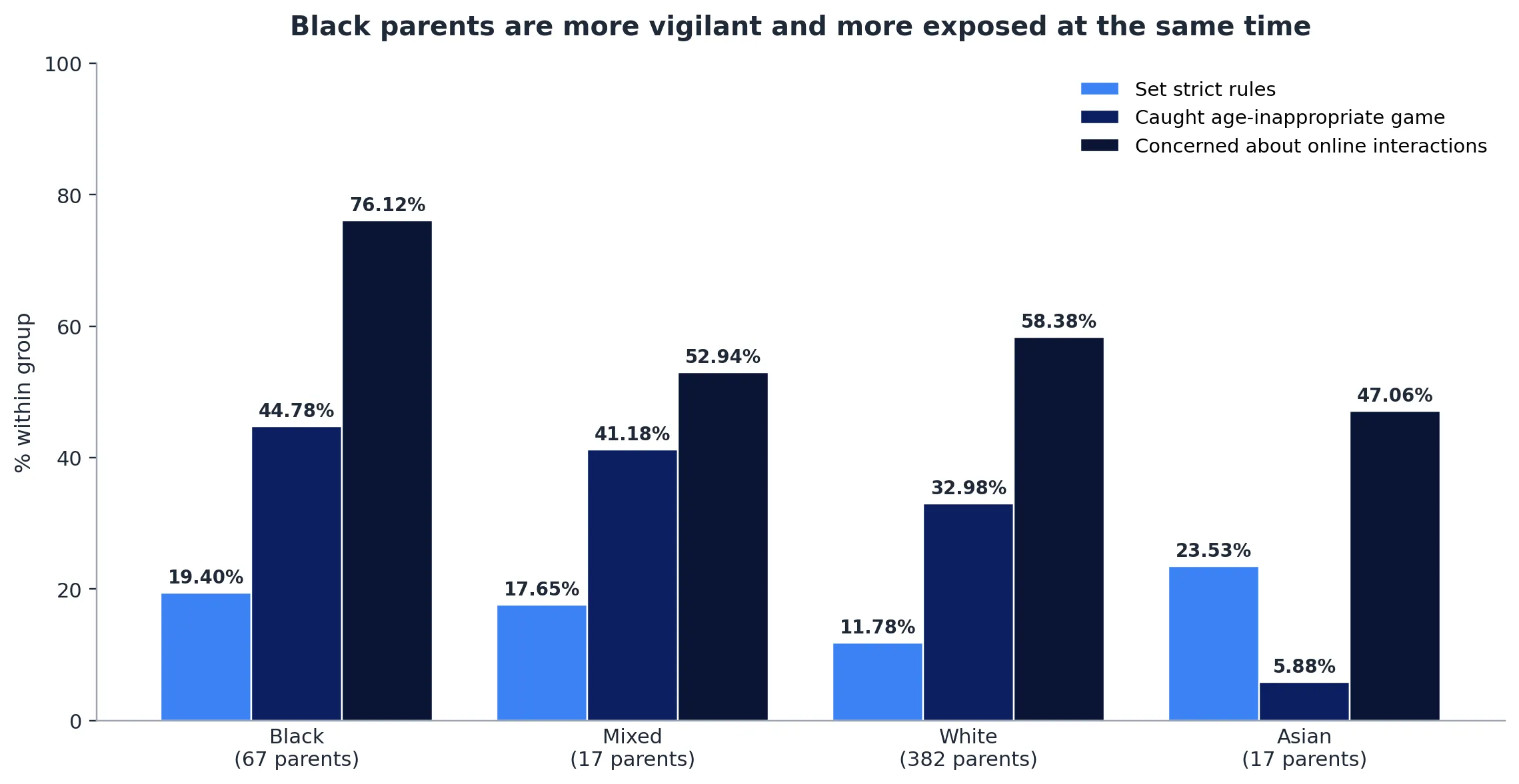
Black parents are more vigilant on every measure and more exposed at the same time.
They are more likely to set strict rules, at 19.40% versus 11.78% for White parents. Black parents are far more likely to be concerned about online interactions, at 76.12% versus 58.38%. But they also report higher heavy-play rates, at 28.36% versus 20.68%, and a higher rate of catching their child with an age-inappropriate game, at 44.78% versus 32.98%. The pattern is more effort, more vigilance, and still more exposure landing.
The 17 Asian parents in this sample are described as indicative rather than precise, but they show the opposite pattern, with low heavy-play and low inappropriate-game discovery rates despite moderate strict-rule adoption.
All the strain measures describe what gaming is doing inside households. Parents also have strong views on the design of today's games and on the companies that produce them.
PART VII | THE INDUSTRY VERDICT
Games today vs games in parent’s childhood
62.43% of parents in this sample say games today are harder for children to stop playing than the games of their own childhood. Only 5.17% say it’s easier, followed by another 28.83% who say it’s about the same.
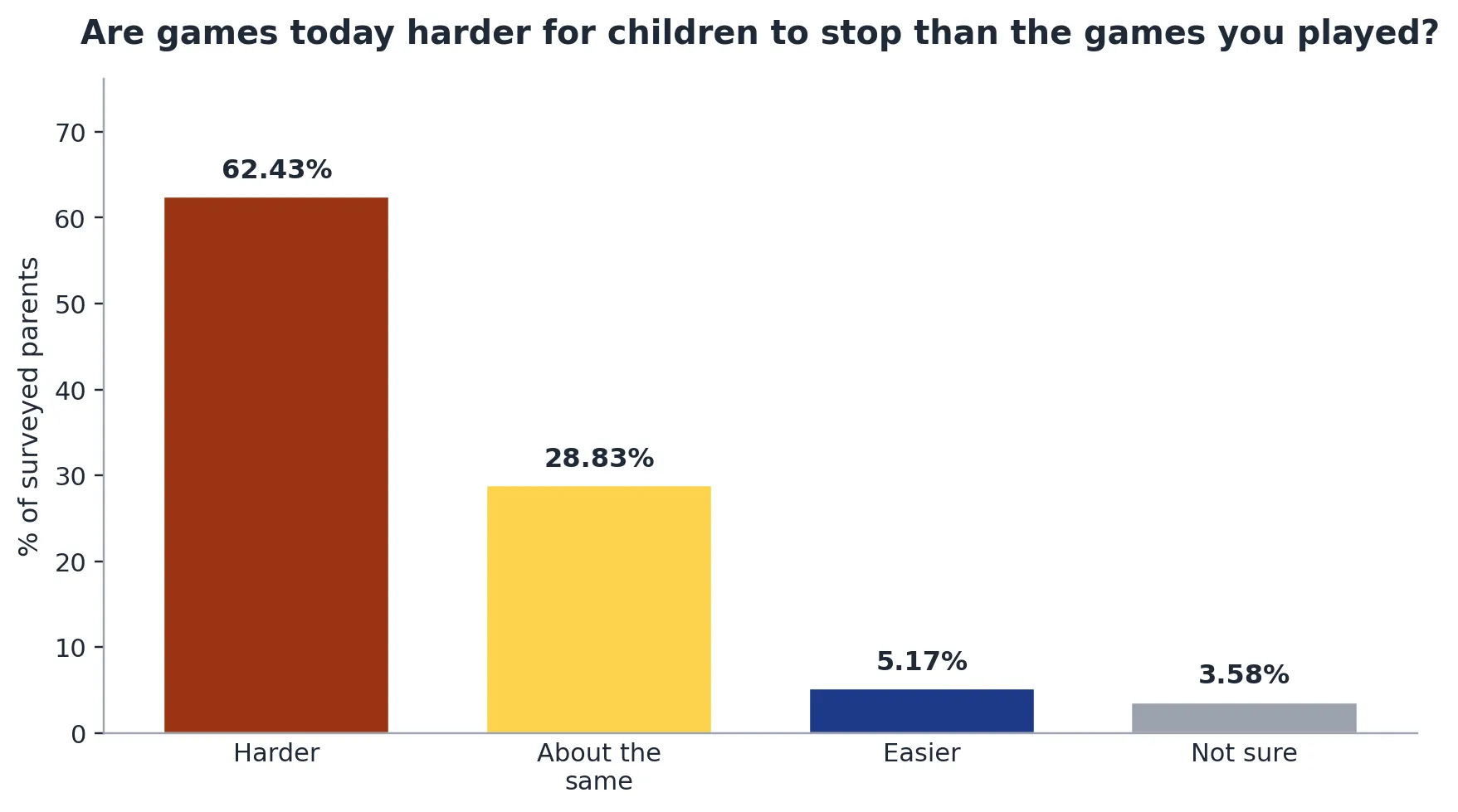
62.43% of US parents say today's games are harder for children to stop playing than the games of their own childhood.
This is one of the most important sentiment findings in the report. The parents answering are not technology skeptics describing something they do not understand, but they are the original Nintendo, PlayStation, and arcade generation, now in their thirties and forties, telling us the design has changed underneath them. The people who grew up with games think today's games have gotten stickier.
That sentiment is strongest among the oldest parents in the sample. 66.41% of parents aged 45 and older say today's games are harder to stop, compared with 63.67% of parents aged 35 to 44, and 53.19% of parents under 35.
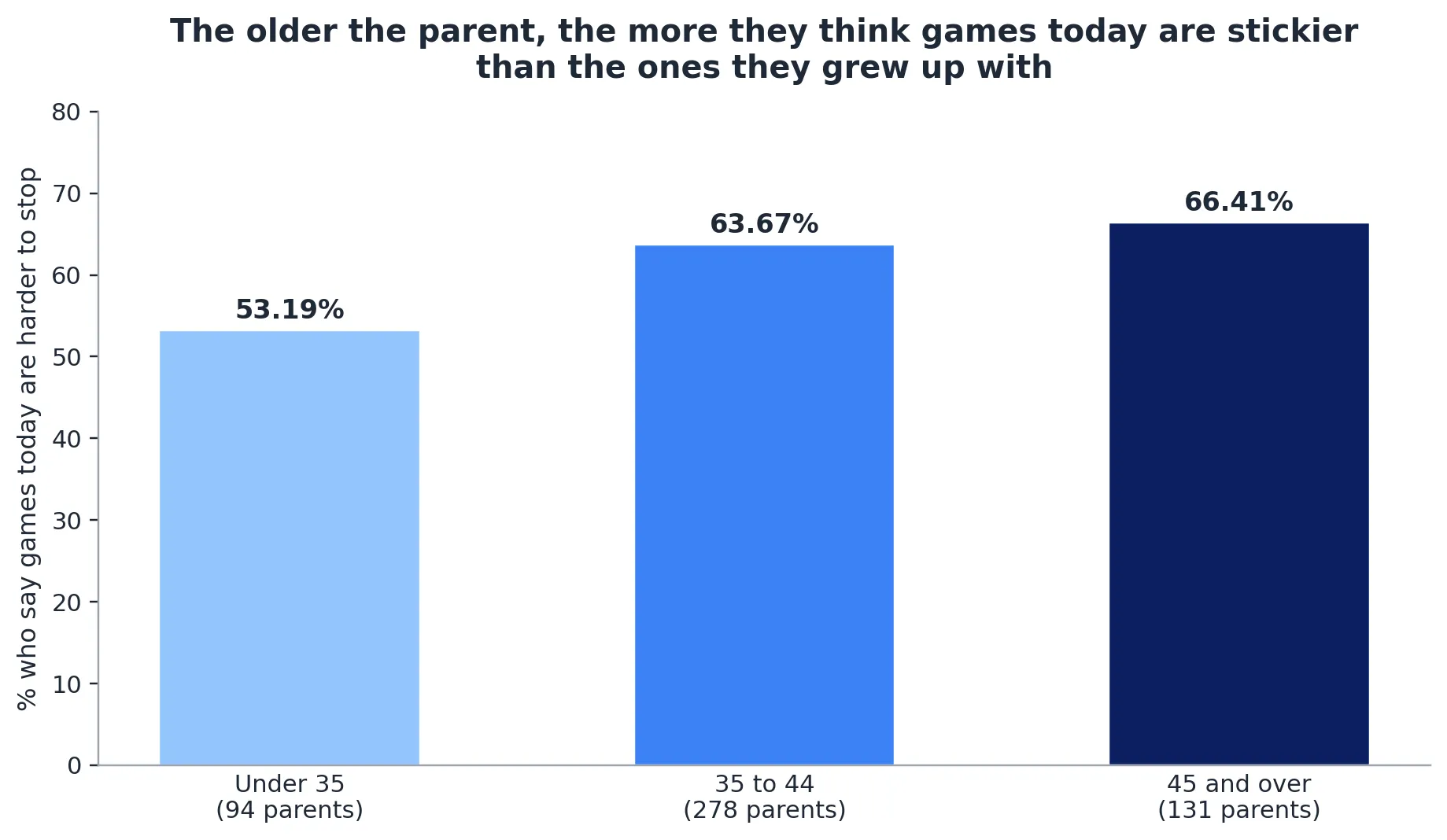
Share of parents who say games today are harder for children to stop playing than the games of their own childhood, broken down by the parent's age.
The under-35 cohort grew up themselves on mobile, free-to-play, and live-service games and find today's design more normal for it. The 45-and-over cohort, whose own childhood gaming meant turning a console off when their parents said so, find it less so. Across all ages, though, patience for the industry that built these games runs thin.
Trust in gaming companies
78.73% of American parents in this sample say gaming companies protect young players 'Not very well' or 'Not well at all.' Only 5 parents in our sample of 503, exactly 0.99%, offered an unambiguous endorsement by selecting 'Very well.'
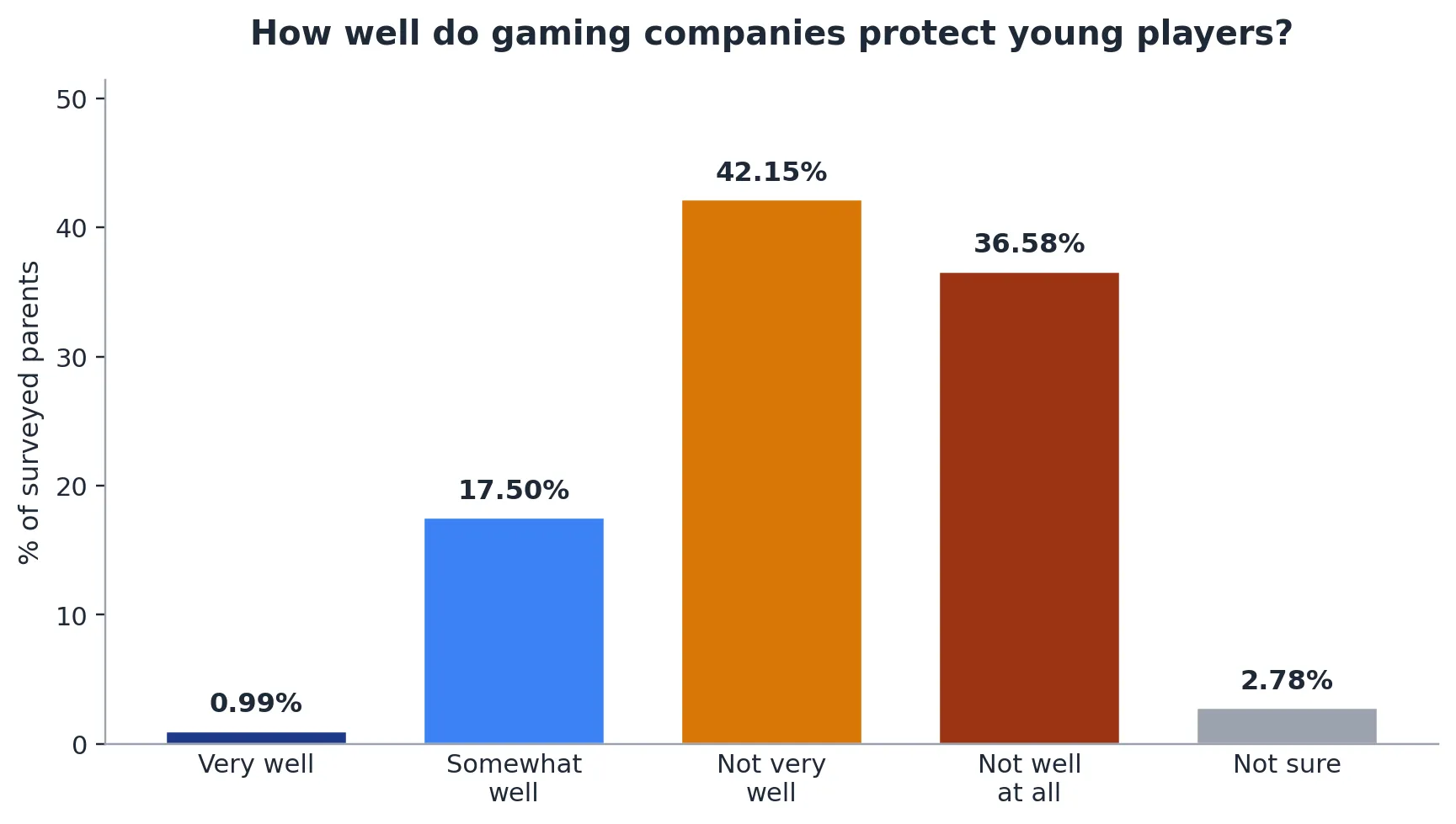
How well do you think gaming companies protect young players?
These trust scores cut across age, ethnicity, parenting style, and political geography. The trust collapse has a date too. The Kids Online Safety Act was reintroduced in May 2025 with bipartisan support. The bipartisan Senate version has been stuck since 2024. If the people elected to protect children cannot agree on how, parents will lose faith in the only other actors who could, which is the companies themselves. The 0.99% endorsement rate is consistent with that.
Low trust in an industry would predict parents pulling their children away from it and last question of our survey asked exactly that, and the answer points in the opposite direction.
Industry distrust, but support for a gaming career runs high
54.67% of American parents in this sample would support their child if they wanted to pursue gaming, streaming, esports, or game development as a career when older. 33.40% would say maybe, and only 6.96% would actively oppose.
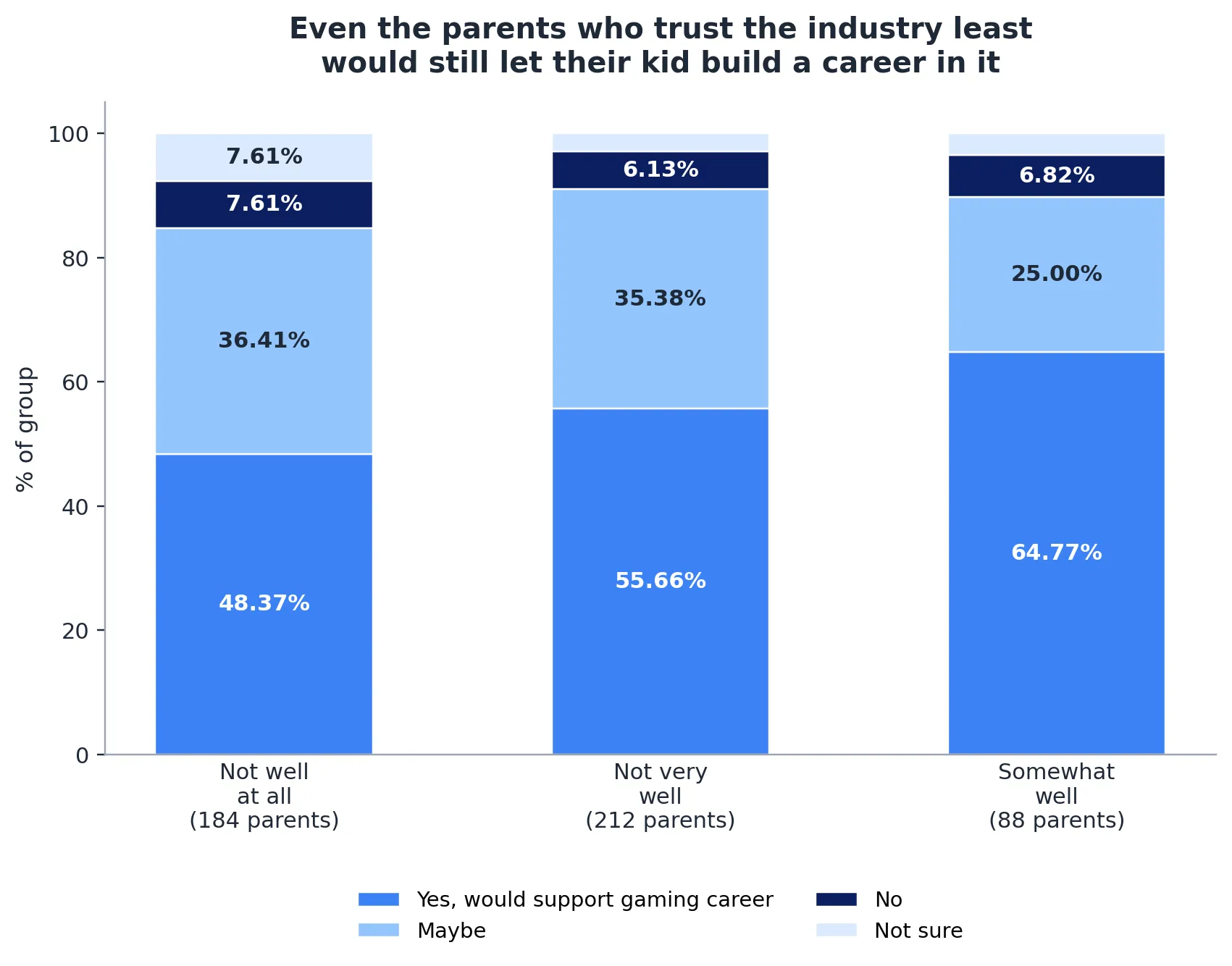
Even among the 184 parents who say the industry protects kids 'Not well at all,' 48.37% would still support a future gaming career for their child.
Among the 184 parents who said gaming companies protect kids 'Not well at all,' 48.37% would still say yes to a gaming career for their child. Only 7.61% of that group would say no. 17.69% of the entire sample sits inside that contradiction directly: they distrust the industry, but would still let their child build a future in it.
The most plausible reading is that American parents understand, correctly, that gaming and gaming-adjacent careers are now legitimate parts of the digital economy with real income paths. Their issue is not with the activity, but with the protection.
What this means
Pulling the threads together:
Gaming is functioning as childcare for the majority of US families with a tween. 93.24% have used it that way; 71.17% use it that way regularly. The pattern is associated with longer play sessions, more household conflict, and a sharply higher rate of children encountering games their parents would rather they did not see.
The standard parental toolkit is not enough on its own. Time rules work, but content controls do not, at least not at the level individual parents can deploy them. The most vigilant parents in the sample catch their child playing age-inappropriate games at essentially the same rate as the most hands-off.
The gaming industry has a credibility problem with the people whose children they sell to. 78.73% say gaming companies protect young players 'Not very well' or 'Not well at all.' Only 0.99% offer an unambiguous endorsement.
American parents are not turning away from gaming. 54.67% would support a career in it. They want their child to play, to be connected, and to be ambitious about gaming as a path. They want the industry to make playing safer.
For platforms and publishers
The cheapest thing the gaming industry could do to recover trust with parents is also the most straightforward. Ship genuinely useful parental controls that work by default, not as a separate setup ritual that 26.44% of parents skip and 1.99% do not know how to start. Provide clearer in-game-purchase friction at the point of pressure, not buried inside account settings. Make age-content filtering a first-class platform feature rather than a per-game option that depends on developer cooperation. The 0.99% endorsement rate is recoverable. It will require visible action, not statements, and the Genshin Impact $20 million settlement is the kind of action parents have already noticed.
For policymakers
The FTC's increasing focus on in-game purchases lines up with the largest purchase-related parental concern in our data: pressure to spend. State-level legislative efforts on loot-box mechanics and age verification have a real constituency. 64.81% of US parents in this sample have at least one named concern about in-game purchases. The same is true of the Roblox multi-district litigation. Parents are watching the cases unfold in real time.
For parents
The single most useful change the data suggests is to uncouple rules about time from rules about content. Time rules work; they really reduce heavy play. Content discovery is a different problem, and it tracks more closely with whether the parent is actively present during gaming, not just whether they have installed software. The parents in this sample who said they actively monitor and actively use parental controls and have strict rules in place still caught their child playing an age-inappropriate game at a 31.03% rate. The most reliable lever appears to be presence: being in the room, knowing the game, sitting in on a session. Not software.
Methodology
This study is based on an online survey of 503 US-resident parents of children aged 8 to 12, recruited via the Prolific research panel and fielded between 29 and 30 April 2026. Respondents were screened on country of residence (United States), parent status, and the year of birth of at least one child (2013 to 2018). The survey covered daily play time, device, household rules, monitoring, parental controls, household arguments, the use of gaming as childcare, child emotional response to gaming limits, parental concerns about sleep, physical activity, schoolwork, online interactions and in-game purchases, school performance, social connection, age-appropriateness, sentiment about gaming companies, and support for a gaming-related career.
Notes on the data:
Headline figures use the full sample of 503 parents. Subgroup and contrast-pair figures use the relevant subgroup size, stated alongside each finding in plain language.
All measures are self-reported by parents. The survey is a single snapshot, and the associations reported here are correlational, not causal. When two findings 'show up together,' they are observed in the same households, not proven to cause one another.
Findings for the smallest subgroups, each under 20 respondents, are described as indicative rather than precise estimates. The Black subgroup of 67 parents and the heavy-gamer subgroup of 105 parents are large enough to support firmer comparison.
Estimates describe this sample. They are not weighted to the entire US population of tween parents.
Data appendix: full response distributions
Every question, in full, organized into four thematic clusters.
Time, device and rules
Daily gaming time
|
Response |
Number of parents |
Share |
|
Does not play daily |
24 |
4.77% |
|
Less than 30 minutes |
33 |
6.56% |
|
30-60 minutes |
130 |
25.84% |
|
1-2 hours |
211 |
41.95% |
|
3-5 hours |
89 |
17.69% |
|
More than 5 hours |
16 |
3.18% |
Primary device
|
Response |
Number of parents |
Share |
|
Console |
144 |
28.63% |
|
PC |
64 |
12.72% |
|
Mobile |
66 |
13.12% |
|
Tablet |
122 |
24.25% |
|
Mixed |
107 |
21.27% |
Rules in place
|
Response |
Number of parents |
Share |
|
Strict rules |
71 |
14.12% |
|
Flexible rules |
376 |
74.75% |
|
Rules exist but are not enforced |
33 |
6.56% |
|
No rules |
23 |
4.57% |
Active monitoring
|
Response |
Number of parents |
Share |
|
Always |
226 |
44.93% |
|
Sometimes |
232 |
46.12% |
|
Rarely |
37 |
7.36% |
|
Never |
8 |
1.59% |
Parental controls
|
Response |
Number of parents |
Share |
|
Yes, actively |
229 |
45.53% |
|
Yes, but rarely checked |
128 |
25.45% |
|
No |
133 |
26.44% |
|
I don't know how |
10 |
1.99% |
|
Not applicable |
3 |
0.60% |
Household dynamics and dependency
Gaming-related arguments
|
Response |
Number of parents |
Share |
|
Never |
96 |
19.09% |
|
Rarely |
228 |
45.33% |
|
Sometimes |
148 |
29.42% |
|
Often |
31 |
6.16% |
Used extra gaming time so parent could focus
|
Response |
Number of parents |
Share |
|
Never |
34 |
6.76% |
|
Rarely |
111 |
22.07% |
|
Sometimes |
294 |
58.45% |
|
Often |
64 |
12.72% |
Child gets upset when asked to stop
|
Response |
Number of parents |
Share |
|
Never |
68 |
13.52% |
|
Rarely |
163 |
32.41% |
|
Sometimes |
203 |
40.36% |
|
Often |
69 |
13.72% |
Predicted reaction to one week without games
|
Response |
Number of parents |
Share |
|
Relieved |
8 |
1.59% |
|
Neutral |
107 |
21.27% |
|
Slightly upset |
220 |
43.74% |
|
Very upset |
165 |
32.80% |
|
Not sure |
3 |
0.60% |
Parental concerns and child outcomes
Concern about sleep
|
Response |
Number of parents |
Share |
|
Not concerned at all |
125 |
24.85% |
|
Not very concerned |
191 |
37.97% |
|
Somewhat concerned |
143 |
28.43% |
|
Very concerned |
44 |
8.75% |
Concern about physical activity
|
Response |
Number of parents |
Share |
|
Not concerned at all |
89 |
17.69% |
|
Not very concerned |
172 |
34.19% |
|
Somewhat concerned |
166 |
33.00% |
|
Very concerned |
76 |
15.11% |
Concern about schoolwork
|
Response |
Number of parents |
Share |
|
Not concerned at all |
151 |
30.02% |
|
Not very concerned |
182 |
36.18% |
|
Somewhat concerned |
123 |
24.45% |
|
Very concerned |
47 |
9.34% |
School performance (parent rating)
|
Response |
Number of parents |
Share |
|
Excellent |
174 |
34.59% |
|
Good |
226 |
44.93% |
|
Average |
91 |
18.09% |
|
Below average |
7 |
1.39% |
|
Struggling |
5 |
0.99% |
Concern about online interactions
|
Response |
Number of parents |
Share |
|
Not concerned at all |
49 |
9.74% |
|
Not very concerned |
90 |
17.89% |
|
Somewhat concerned |
176 |
34.99% |
|
Very concerned |
129 |
25.65% |
|
My child does not play online |
59 |
11.73% |
Caught child playing age-inappropriate game
|
Response |
Number of parents |
Share |
|
Yes |
171 |
34.00% |
|
No |
323 |
64.21% |
|
Not sure |
9 |
1.79% |
Gaming helps child connect with friends
|
Response |
Number of parents |
Share |
|
Not at all |
90 |
17.89% |
|
A little |
142 |
28.23% |
|
Somewhat |
148 |
29.42% |
|
A lot |
114 |
22.66% |
|
Not sure |
9 |
1.79% |
Industry sentiment and the future
Top in-game purchase concern
|
Response |
Number of parents |
Share |
|
Overspending |
87 |
17.30% |
|
Pressure to spend |
132 |
26.24% |
|
Hidden costs |
48 |
9.54% |
|
Lack of parental controls |
59 |
11.73% |
|
Not concerned |
21 |
4.17% |
|
My child does not make in-game purchases |
156 |
31.01% |
Games today vs games when parent was a child
|
Response |
Number of parents |
Share |
|
Harder |
314 |
62.43% |
|
About the same |
145 |
28.83% |
|
Easier |
26 |
5.17% |
|
Not sure |
18 |
3.58% |
How well gaming companies protect young players
|
Response |
Number of parents |
Share |
|
Very well |
5 |
0.99% |
|
Somewhat well |
88 |
17.50% |
|
Not very well |
212 |
42.15% |
|
Not well at all |
184 |
36.58% |
|
Not sure |
14 |
2.78% |
Would support a future gaming-related career
|
Response |
Number of parents |
Share |
|
Yes |
275 |
54.67% |
|
Maybe |
168 |
33.40% |
|
No |
35 |
6.96% |
|
Not sure |
25 |
4.97% |
Suggested citation
LDshop (2026). The American Tween Gaming Reality Check: What 503 American parents told us about gaming, childcare, and the line between play and dependency. Published by LDshop, April 2026.
About LDshop
LDShop is a global game top-up platform, offering players discounted in-game currency, gift cards, and recharge services across hundreds of popular titles, including Genshin Impact, PUBG Mobile, and Fortnite. Trusted by gamers worldwide, LDShop provides fast, secure transactions and localized customer support across multiple languages.